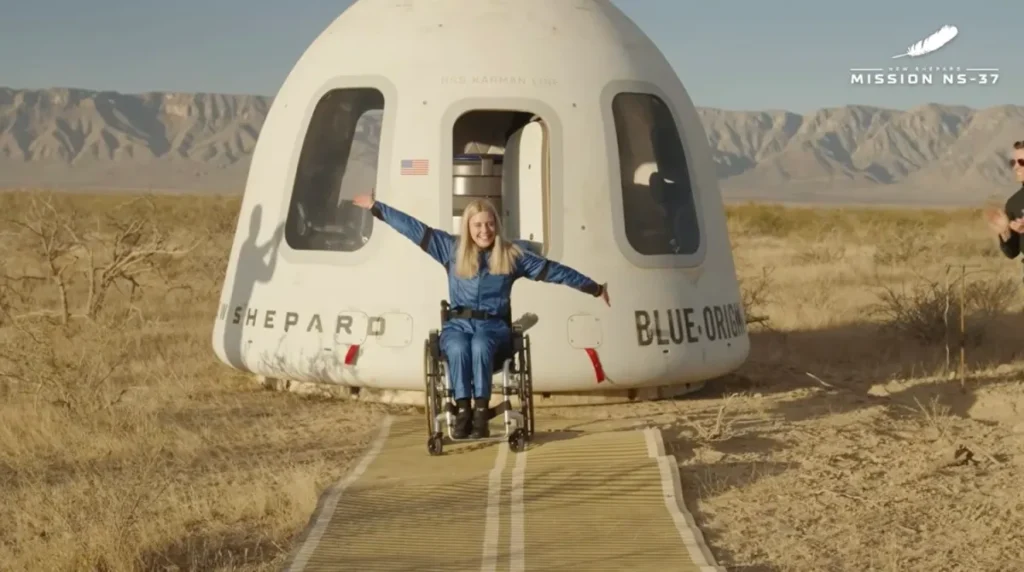
Blue Origin made history Saturday when Michaela “Michi” Benthaus — a wheelchair user in daily life after a spinal cord injury — flew above the Kármán line, the 100-kilometer (62-mile) altitude commonly used to mark the boundary of space.
Benthaus was one of six passengers on New Shepard’s NS-37 mission, which launched from Blue Origin’s Launch Site One in West Texas. The suborbital flight lasted about 10 minutes and included several minutes of weightlessness before the capsule returned to the desert under parachutes.
Who Michi Benthaus is
Benthaus is an aerospace and mechatronics engineer associated with the European Space Agency. She sustained a spinal cord injury in a 2018 mountain biking accident, and she has spoken publicly about how that changed her day-to-day mobility and her view of accessibility.
Ahead of the mission, Benthaus told media she had waited “very long” for the chance to fly. “I am excited to show the world that also wheelchair users can go on a suborbital flight,” she said, adding that she was happy Blue Origin supported her participation.
The NS-37 crew and what Blue Origin said
Blue Origin listed the NS-37 crew as Benthaus, Joey Hyde, Hans Koenigsmann, Neal Milch, Adonis Pouroulis, and Jason Stansell. In a post-flight statement, the company said the mission marked the first time a wheelchair user had flown above the Kármán line.
Blue Origin also said the flight brought its total to 92 people (86 individuals) flown into space across the New Shepard program.
Accessibility and what was required on launch day
Blue Origin has emphasized that New Shepard and its launch infrastructure were designed with accessibility in mind, including elevator access on the launch tower. In its statement, the company said the vehicle’s autonomous design and tower access help make spaceflight available to a wider range of people.
The Associated Press reported that only minor accommodations were needed for Benthaus on launch day and during recovery, including equipment to help her transfer and support to ensure she could quickly access her wheelchair after landing.
AstroAccess and the broader push for disability inclusion
The milestone also drew attention to AstroAccess, a project focused on disability inclusion in human space exploration and accessible spaceflight design. AstroAccess describes itself as part of SciAccess, Inc., a nonprofit dedicated to advancing disability inclusion in STEM.
Advocates have long argued that broadening participation in spaceflight requires more than goodwill. It depends on practical design choices in vehicles, ground systems, procedures, and training — the kinds of details that can either expand access or quietly make it harder for some people to participate.
Why this moment matters
Commercial suborbital flights are brief, but they involve real spacecraft operations: launch loads, high-altitude environments, microgravity, and recovery procedures. For accessibility advocates, demonstrating that a wheelchair user can take part without major redesign is a meaningful proof point.
Blue Origin framed Benthaus’ flight as a signal that spaceflight can include a wider mix of people and backgrounds. What happens next will depend on whether companies and agencies translate milestone moments into repeatable pathways that more disabled candidates can use.
Sources:
Associated Press – “Paraplegic engineer becomes the first wheelchair user to blast into space”
ABC News – “For the 1st time ever, a person who uses a wheelchair will fly to space”