CAPE CANAVERAL, Fla. — A stray comet from another star system is swinging past Earth this week in one last close-up moment before it heads back out into interstellar space.
The icy visitor, known as interstellar comet 3I/Atlas, will pass about 167 million miles (269 million kilometers) from our planet on Friday — the nearest point in its brief tour through the inner solar system, according to NASA.
Astronomers estimate that 3I/Atlas is somewhere between 1,444 feet (440 meters) and 3.5 miles (5.6 kilometers) across, making it a substantial chunk of rock and ice by comet standards.
A safe, distant flyby and a fading target
Despite the headlines, this is a distant, safe encounter. At 167 million miles away, 3I/Atlas is more than 700 times farther than the Moon, posing no threat to Earth.
For scientists and skywatchers, though, the timing matters. The comet is already fading as it recedes from the Sun, which means this week offers one of the last good chances to observe it before it dims beyond the reach of many telescopes.
NASA has been turning some of its most powerful space-based observatories toward the comet, including the Hubble Space Telescope and other spacecraft positioned around the solar system. Their goal is to capture as much data as possible while 3I/Atlas is still relatively bright and accessible.
Backyard astronomers with medium to large telescopes under dark skies may still be able to pick it out as a faint smudge, but it won’t be a naked-eye showpiece.
Heading for Jupiter, then interstellar space
Earth won’t be the comet’s closest encounter with a planet. In March, 3I/Atlas will swing much nearer to Jupiter, passing within about 33 million miles (53 million kilometers) of the giant planet.
That flyby will bend its path slightly, but not enough to keep it around. Paul Chodas, director of NASA’s Center for Near Earth Object Studies, said the comet will continue on a hyperbolic trajectory and is expected to leave the solar system entirely by the mid-2030s, never to return.
Once it crosses the outer boundary of the Sun’s gravitational influence, 3I/Atlas will rejoin the thin stream of interstellar debris drifting between the stars.
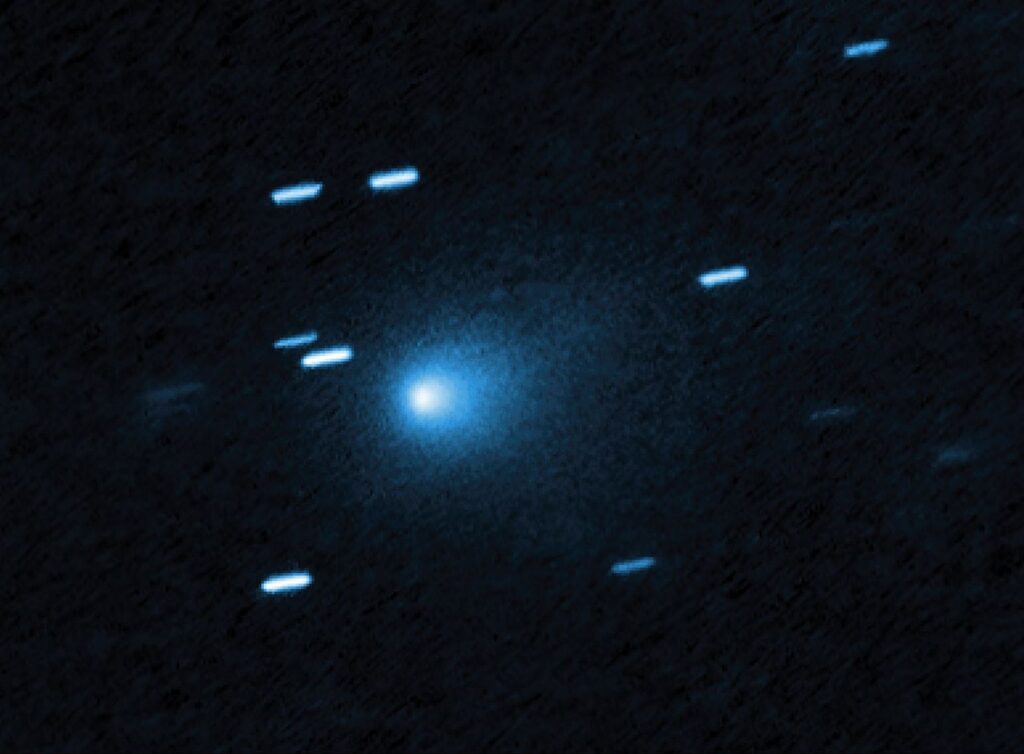
The third known visitor from another star
Interstellar comet 3I/Atlas is only the third confirmed object from another star system ever seen passing through ours. The first, the oddly shaped object known as 1I/ʻOumuamua, was spotted in 2017. It was followed in 2019 by 2I/Borisov, a more conventional-looking comet.
Unlike the billions of “home-grown” comets that originate in the distant reaches of our own solar system, interstellar comets are born around other stars and arrive on open-ended, hyperbolic orbits. Their paths and speeds reveal that they are just passing through, not bound to the Sun.
Since 3I/Atlas formed in a different planetary system — likely billions of years ago — its ices and dust preserve a chemical record of conditions that were never present here. That makes it a particularly valuable target for scientists trying to understand how stars and planets form across the Milky Way.
A rare chance for astronomers and hobbyists
NASA’s discovery of 3I/Atlas in July, using its ATLAS survey telescope in Chile, triggered a rapid international observing campaign. Ground-based observatories and space missions have been tracking the comet as it looped around the Sun, passed near Mars and now glides past Earth’s orbit.
Some observations have already revealed unusual details. Spectral measurements suggest that the comet’s ices are rich in certain molecules, such as methanol and hydrogen cyanide, which are key ingredients in prebiotic chemistry. Those findings hint that even small, icy bodies formed around other stars might help seed basic building blocks of life when they cross paths with young planetary systems.
For amateur astronomers, 3I/Atlas is more of a subtle challenge than a show-stopping spectacle — a faint, fast-moving smudge that rewards patient tracking and dark skies rather than casual stargazing. But for professionals, it’s a once-in-a-career opportunity to sample material from another star system without ever leaving our own.
After this brief visit, interstellar comet 3I/Atlas will fade from view and slip back into the dark between the stars, leaving behind only data, images, and a few years’ worth of hard-won insights into worlds far beyond the Sun’s reach.
Sources:
AP News – “Interstellar comet keeps its distance as it makes its closest approach to Earth”
PBS / AP – “NASA says new interstellar comet it spotted will keep a safe distance from Earth”