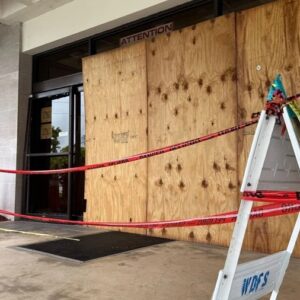
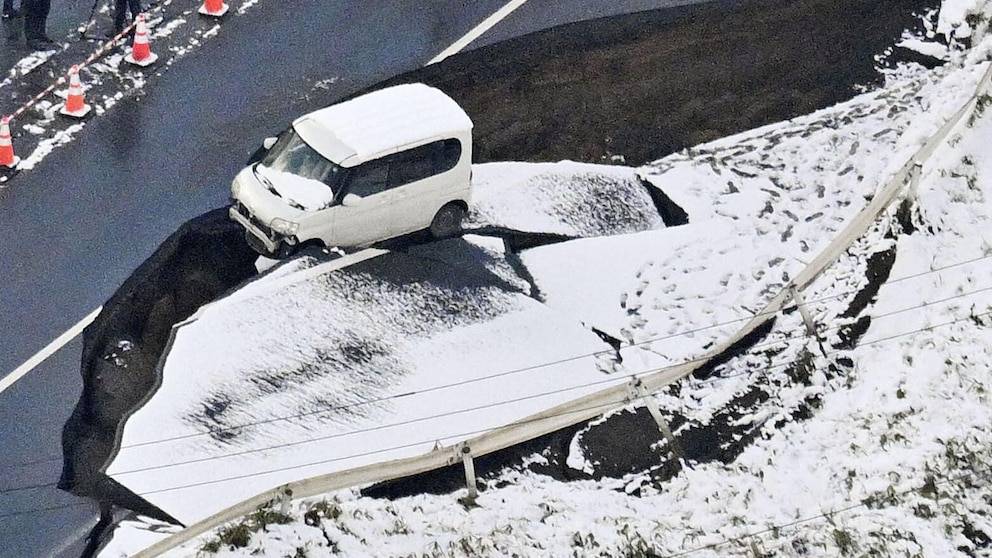
Japan was assessing damage and warning residents about possible aftershocks on Tuesday after a powerful late-night quake rattled the country’s northeast, causing light damage, injuries, and a small tsunami along parts of the Pacific coast.
The Japan 7.5 magnitude earthquake struck at about 11:15 p.m. local time on Monday in the Pacific Ocean, roughly 80 kilometers (50 miles) off the coast of Aomori, Japan’s northernmost prefecture on the main island of Honshu. The Japan Meteorological Agency (JMA) measured it at magnitude 7.5, while the U.S. Geological Survey put it at 7.6 and said it originated about 44 kilometers (27 miles) below the surface.
At least 34 people were injured, one of them seriously, according to the Fire and Disaster Management Agency. Public broadcaster NHK reported that most of the injuries were caused by falling objects during the strong shaking.
Prime Minister Sanae Takaichi told reporters that an emergency task force had been set up to quickly assess the damage and coordinate the response. “We are putting people’s lives first and doing everything we can,” she said, later telling Parliament that the government would continue to make its utmost efforts while reminding residents that they also had to take steps to protect themselves.
Tsunami waves, transport disruption and power outages
The quake generated a modest tsunami along parts of the northeastern coast. At Kuji port in Iwate prefecture, just south of Aomori, JMA measured waves up to 70 centimeters (2 feet, 4 inches). Other coastal communities reported waves of up to about 50 centimeters. NHK said some oyster rafts in the area were damaged.
Tsunami advisories were issued shortly after the quake for stretches of the Pacific coast, but JMA lifted all advisories by around 6:30 a.m. Tuesday after no large waves were observed and the initial surge subsided.
On land, the shaking briefly disrupted power and transport. Chief Cabinet Secretary Minoru Kihara said about 800 homes were without electricity overnight in the affected region. By Tuesday morning, power had been restored to most customers, according to Tohoku Electric Power Co.
Shinkansen bullet trains and some local lines were suspended in parts of northeastern Japan in the early hours of Tuesday while tracks and equipment were inspected. East Japan Railway later said bullet train services had resumed in the region after safety checks were completed.
Airport damage and nuclear safety checks
The quake also affected air travel. About 200 passengers were stranded overnight at New Chitose Airport on the northern island of Hokkaido after part of a domestic terminal became unusable when sections of the ceiling cracked and fell to the floor, NHK reported. Some flights were delayed or canceled as crews inspected the damage.
Japan’s nuclear watchdog said there were minor issues but no threat to safety at nuclear-related facilities. The Nuclear Regulation Authority reported that about 450 liters (118 gallons) of water spilled from a spent fuel cooling area at the Rokkasho fuel reprocessing plant in Aomori. Officials said the water level remained within the normal range and there was no radiation concern. No abnormalities were detected at other nuclear power plants or spent fuel storage facilities.
Japan, which sits on the seismically active Pacific “Ring of Fire,” has tightened safety rules and emergency procedures at its nuclear sites since the 2011 Fukushima Daiichi disaster. Routine post-quake inspections are now standard whenever a major tremor hits.
Aftershocks and warning of heightened quake risk
JMA warned that aftershocks could continue in the coming days and highlighted a slight increase in the risk of a larger quake along Japan’s northeastern coast, stretching from Chiba, just east of Tokyo, up to Hokkaido. Officials said there was a possibility of a magnitude 8-level event and accompanying tsunami, but stressed that the advisory was not a prediction that such a “big one” would definitely occur.
The agency urged residents in 182 municipalities in the region to review their evacuation routes, check emergency supplies and stay alert for updated information over the next week. “You need to prepare, assuming that a disaster like that could happen again,” JMA official Satoshi Harada said.
Smaller aftershocks were already being recorded on Tuesday. The U.S. Geological Survey reported a magnitude 6.6 quake and, later, a 5.1 quake in the same general offshore area in the hours after the initial temblor.
A stark reminder of the 2011 disaster zone
Monday’s earthquake struck just north of the coastal region devastated in 2011, when a magnitude 9.0 quake and massive tsunami killed nearly 20,000 people and crippled the Fukushima Daiichi nuclear plant.
The memory of that catastrophe remains vivid in northeastern Japan, where regular drills, seawalls and rebuilt infrastructure are tangible reminders of the country’s vulnerability to major quakes and tsunamis. For many residents, the latest shaking and tsunami alerts were an unwelcome but familiar test of the systems and habits developed since 2011.
As inspections continue and more detailed damage reports emerge, officials say their focus remains on confirming that there are no people trapped or communities cut off — and on using the Japan 7.5 magnitude earthquake as another prompt to reinforce long-term preparedness in one of the world’s most earthquake-prone nations.
Sources:
AP News – “Japan assesses damage from 7.5 magnitude quake that injured 34”
Reuters – “Japan lifts tsunami warning after 7.5-magnitude earthquake”