A New York City high school senior has been ordered jailed on a federal arson charge after authorities said he set a fire that severely burned a sleeping subway passenger on Manhattan’s west side.
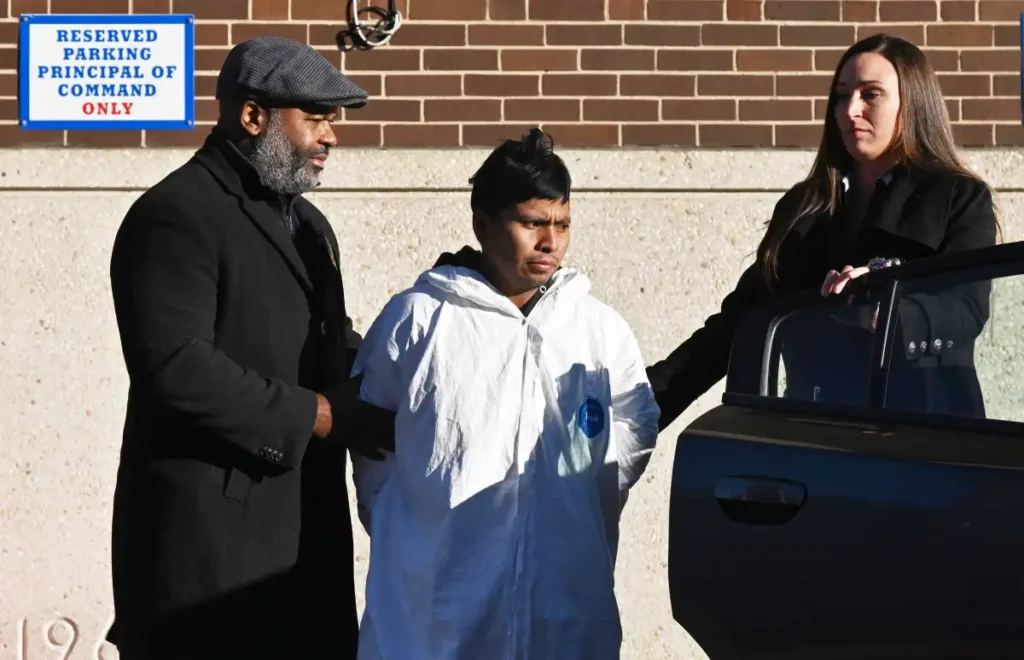
Hiram Carrero, 18, appeared in Manhattan federal court on Friday, four days after the early-morning attack. He was not required to enter a plea. Prosecutors say he briefly boarded a northbound 3 train at 34th Street–Penn Station, lit a piece of paper near a 56-year-old man who was asleep and then fled.
The passenger stumbled off at the next stop, 42nd Street–Times Square, with flames engulfing his legs and torso. Officers on the platform extinguished the fire, and the man was taken to the hospital in critical condition. “The victim very well could have died in this case,” prosecutor Cameron Molis told the court.
The incident is the latest in a troubling series of cases in which people have been set alight on public transport across the United States.
How the alleged attack unfolded underground
According to a criminal complaint, Carrero stepped onto the train only briefly in the early hours of Monday, around 3 a.m., while it was stopped at 34th Street–Penn Station, near Madison Square Garden and Macy’s flagship department store.
Investigators say he ignited a piece of paper and dropped it near the sleeping passenger before stepping back onto the platform and leaving the station, as the victim’s clothes caught fire. Surveillance images from 42nd Street–Times Square show the man struggling along the platform with flames burning up his legs and torso before police intervened.
Carrero then took a bus home, according to the complaint. He was arrested on Thursday in Harlem, where his lawyer said he lives with his disabled mother and acts as her primary carer, bringing her to medical appointments. She attended his arraignment but declined to speak to reporters.
If convicted on the federal arson charge, Carrero faces a mandatory minimum of seven years in prison. A preliminary hearing has been set for 4 January, although that date will be cancelled if prosecutors secure an indictment from a grand jury before then.
Judge calls alleged crime ‘heinous’ and reverses home confinement
The question of whether Carrero should be held in custody became a central issue at Friday’s hearing. Magistrate Judge Robert W. Lehrburger initially agreed to release him to home confinement, with electronic monitoring, mental health evaluation and drug testing, under his mother’s supervision.
But prosecutors immediately appealed. At an after-hours hearing, U.S. District Judge Valerie E. Caproni ordered Carrero detained, citing what she called the “heinousness of the crime.”
“It’s hard for me to understand why an 18-year-old young man who’s in high school is out at 3 o’clock in the morning setting people on fire,” Caproni said from the bench. She concluded that the risk to public safety outweighed the arguments for supervised release.
Carrero’s lawyer, Jennifer Brown, did not dispute the seriousness of the allegations, describing him as “a very young man with no record and a mother willing to take him in.” She also pointed to early news reports suggesting investigators had considered whether the victim might have set himself on fire — a possibility that has not been adopted in the federal complaint.
For now, Carrero will remain in custody at a federal facility as the investigation continues.
Letitia James Faces Federal Charges of Mortgage Fraud Amid Backlash
Investigators trace the suspect through video and a prior stop
Carrero’s case landed in federal court in part because it was investigated by the New York Arson and Explosives Task Force, a joint unit led by the Bureau of Alcohol, Tobacco, Firearms and Explosives alongside New York’s police and fire departments.
According to the complaint, investigators began zeroing in on Carrero by matching images of the suspected arsonist with police body-worn camera footage from October, when officers stopped him for cycling through a red light while he was delivering food for Uber Eats.
In both sets of images, the man wore the same distinctive moustache, hat with white lettering across the front, backpack and grey hooded sweatshirt. That visual match — combined with the timing and location data captured by surveillance cameras — led investigators to identify Carrero as the suspect.
The case is being prosecuted solely at the federal level; at present, he faces no parallel charges in New York state court.
Part of a broader pattern of transit fire attacks
The New York case has drawn fresh attention in part because it follows other shocking incidents of passengers being set on fire in train systems across the country.
Last month, federal prosecutors in Chicago charged 50-year-old Lawrence Reed with a terrorism offence after he allegedly poured petrol on a 26-year-old woman and set her on fire aboard a Chicago Transit Authority Blue Line train. The woman was chased through the carriage and remains in critical condition; Reed faces a potential life sentence if convicted.
In New York, memories are still raw from a December 2024 attack in which a sleeping woman, later identified as 57-year-old Debrina Kawam of New Jersey, was set on fire and killed on a stationary F train at Coney Island–Stillwell Avenue station. Prosecutors say she was doused with flame from a lighter and that the suspect used a shirt to fan the blaze as she burned to death. A man has since been indicted on murder and arson charges in that case.
For transit riders, the latest NYC subway arson case underlines a wider sense of vulnerability — particularly for people sleeping on trains, many of whom are experiencing homelessness or mental health crises. For prosecutors, it is another reminder that seemingly small acts — a piece of burning paper, a spark from a lighter — can turn enclosed public spaces into scenes of catastrophic violence.
As Carrero awaits his next court date, the victim remains in the hospital with severe burns, and investigators continue to build a case they say shows not only what happened in a single train carriage but how dangerous the system can become when fire is used as a weapon.