TikTok has signed binding agreements to form a new U.S. joint venture backed by Oracle Corporation, Silver Lake, and Abu Dhabi–based MGX, according to an internal memo from CEO Shou Chew obtained by media. The deal is designed to meet a U.S. law that would otherwise force a nationwide TikTok ban unless its Chinese parent company, ByteDance, ceded control of its American business.
Chew told employees that “there’s more work to be done” as the parties move toward a January 22, 2026, closing date, but said the agreement “enabl[es] over 170 million Americans to continue discovering a world of endless possibilities as part of a vital global community.”
Under the structure described in the memo and in public filings, Oracle, Silver Lake, and MGX will each own 15% of the new entity. Another 30.1% will be held by affiliates of existing ByteDance investors, while ByteDance itself will retain a 19.9% minority stake, leaving just under 80.1% of the U.S. unit in non-Chinese hands to satisfy divestment rules.
Years-long Washington–Beijing saga reaches a turning point
The agreement is the culmination of a prolonged political and regulatory battle over TikTok’s presence in the United States. Last year, Congress passed a “divest-or-ban” law requiring TikTok to be removed from U.S. app stores unless ByteDance sold or restructured its American operation under U.S. control.
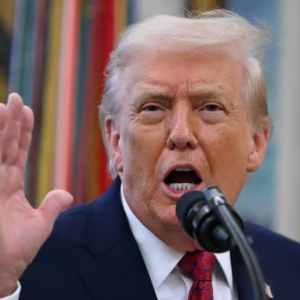
In September 2025, the White House unveiled details of a framework deal with Beijing that would allow TikTok to survive in the U.S. under a new corporate structure. That framework was later blessed by an executive order signed by President Donald Trump on Sept. 25, 2025, which declared the proposed divestiture a “qualified” solution for national security purposes.
Chew’s memo says the new joint venture will be governed by a seven-member, majority-American board and explicitly references Trump’s executive order, noting that the agreements comply with its requirement that the U.S. venture be majority owned by American investors and subject to strict national security terms.

Oracle to oversee U.S. data, algorithm, and security
The internal memo and U.S. officials describe the U.S. entity as responsible for U.S. data protection, algorithm security, content moderation and software assurance. Oracle will serve as the “trusted security partner” charged with auditing and validating compliance with national security conditions after the transaction closes.
As part of a September framework outlined by the White House, a copy of TikTok’s recommendation algorithm — the “secret sauce” behind its viral feed — will be brought under the U.S. joint venture’s control and housed on Oracle infrastructure. The algorithm copy will be retrained on U.S. user data, with Oracle providing security and access controls, to comply with both U.S. and Chinese law while limiting Beijing’s direct influence over what American users see.
ByteDance is expected to continue handling global advertising, e-commerce and other revenue-generating operations from outside the U.S., while the American venture focuses on compliance and operations inside the United States.
Australia’s social media ban for under-16s takes effect
Concerns over media consolidation and Trump ties
Privacy, antitrust and free-speech advocates have raised early concerns about the investor lineup. Oracle co-founder Larry Ellison is the company’s largest shareholder and a close ally of President Trump. Ellison associates also have stakes in major media assets, including Paramount Global, which controls CBS, and have reportedly explored acquiring Warner Bros. Discovery, leading critics to worry about further concentration of media and tech power in a small circle of Trump-aligned billionaires.
Civil liberties groups also warn that placing TikTok’s U.S. content moderation and algorithm oversight in the hands of a politically connected consortium could invite subtle forms of censorship or political favoritism, even as the deal is framed as a way to protect U.S. users from foreign influence.
What’s next for TikTok users and regulators
For TikTok’s 170 million-plus American users, the company insists that the experience of using the app will remain largely unchanged in the short term. The new structure is meant to run underneath the product, ensuring that data is stored in the U.S. and that national security rules are met, while creators, advertisers and users keep posting and scrolling.
But the transaction still needs to clear some hurdles. U.S. regulators will review the final agreements, and Chinese authorities must sign off on the transfer of a licensed algorithm copy and the new corporate structure. Lawmakers on both sides of the aisle have signaled they will scrutinize the details to see whether the deal truly severs sensitive ties to ByteDance or leaves gaps that could allow backdoor influence.
For now, Chew is presenting the joint venture as the end of a long and uncertain saga. If the deal closes on schedule in January 2026, TikTok will have avoided a U.S. ban — at the price of handing significant control over its American operations to a new, Oracle-anchored TikTok US joint venture.
Sources:
Axios – “Scoop: TikTok signs deal for U.S. unit after yearslong saga”