In Bac Ninh, north of Hanoi, the change is visible in everyday details: storefronts marked with foreign-language signage and a food scene shaped by an influx of workers and managers from abroad.
Long associated with rice farming and the call-and-response love songs of Quan Ho, Bac Ninh has evolved into one of Vietnam’s busiest industrial corridors. The shift has been accelerated by a rush of new investment tied to President Donald Trump’s tariff increases, which have added momentum to the broader reordering of factories across Asia.
Vietnam has gained from the push-and-pull between Washington and Beijing, as manufacturers moved capacity out of China. Earlier waves of Japanese and South Korean investment helped turn the country into a major production base. But the pace of growth is revealing pressure points—higher wages, a tightening labor pool, and infrastructure that has not kept up.
Samsung’s early bet and the latest China-driven wave
Bac Ninh’s first major industrial surge began around 2008, when Samsung built its first phone factory there—an investment that helped make Vietnam the company’s largest offshore manufacturing base.
Now, Chinese firms are expanding rapidly in Bac Ninh as they spread production across multiple countries to reduce exposure to U.S. tariffs and other trade constraints. After Vietnam and China restored relations in the 1990s, Chinese capital flows rose steadily, with companies drawn to Vietnam’s electronics ecosystem, available labor, and local authorities viewed as business-friendly. In places like Bac Ninh, Chinese-speaking intermediaries have played a key role in handling documentation and logistics.
Still, Vietnam cannot substitute for China’s scale. China’s economy is about 40 times larger, underscoring why Vietnam’s leaders are investing heavily to increase capacity.
Building roads, rails, and a bigger industrial footprint
To support the industrial expansion, Vietnam is pushing new infrastructure projects, including a highway to the Chinese border that has reduced travel time by more than an hour. A railway is planned to link Hanoi to Haiphong—Vietnam’s largest seaport—and then continue to the border town of Lao Cai.
On Dec. 19, Bac Ninh broke ground on an expansion of an industrial zone aimed at higher-tech production, including electronics, pharmaceuticals, and clean energy. The project is part of a wider national drive in which Vietnam launched 234 major projects worth more than $129 billion shortly before a pivotal National Party Congress in January, when leaders are expected to set the next course for political leadership and economic strategy.
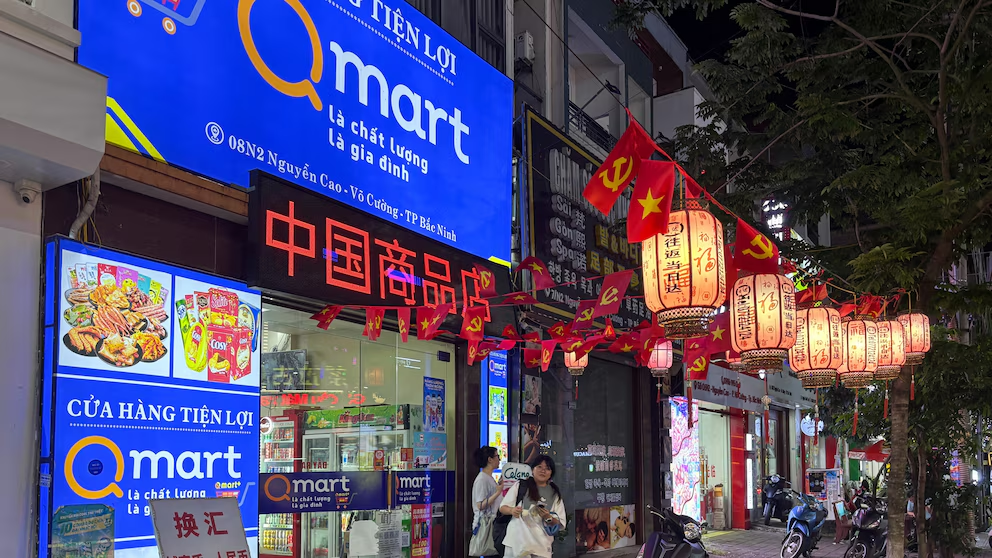
The costs of “China plus one” are rising
Downtown Bac Ninh now features businesses tailored to foreign investors, including a convenience store named after Alibaba’s Tmall platform. Chinese-language signs advertise services geared to new arrivals, and Chinese–Vietnamese language schools have opened to help residents and expatriates communicate.
But the same influx is intensifying competition for workers and resources, raising the price of “China plus one”—the strategy of adding production outside China, as seen in moves such as Apple’s shift into India.
“It is becoming difficult to recruit workers,” said Peng, an employee at a telecom equipment company that relocated from Shenzhen. He shared only one name, saying he was not authorized to speak publicly.
Peng said labor costs have climbed 10% to 15% since 2024 and are expected to keep rising.
Finland Arrests Two After Undersea Telecom Cable Damage
Why China remains hard to replicate
Even as production spreads, businesses say Vietnam still depends heavily on Chinese technology, machinery, and know-how. Jacob Rothman, co-founder and CEO of China-based Velong Enterprises—which makes grill tools and kitchen gadgets and has moved some output to countries including Cambodia and Vietnam—said China built “the best manufacturing ecosystem” through years of state backing, investment, and scale.
“You can’t recreate that overnight,” Rothman said.
Brian Bourke, global chief commercial officer at U.S.-based SEKO Logistics, said factories producing footwear, furniture, and technology are still relocating to Vietnam, but the country trails China in infrastructure and logistics capacity. In Bac Ninh, companies have tried to attract workers with higher pay, bonuses, first-day incentives such as instant noodles, and even bus fare support for commuters, according to state media.
Tariffs, trade surpluses, and a push to diversify
Vietnam has been one of the biggest beneficiaries of Trump’s trade war. The U.S. remains its largest export destination. In 2024, Vietnam posted a $123.5 billion trade surplus with the United States, the third largest after China and Mexico. That drew Trump’s attention: he threatened a 46% import tax on Vietnamese goods before settling on 20%.
Vietnam and the U.S. are still working toward an arrangement to keep most tariffs at 20%. The White House said in October that Vietnam offered broad preferential access for U.S. goods. Vietnam has largely absorbed the tariffs so far, running a $121.6 billion surplus from January through November 2025.
An October agreement between Trump and Chinese leader Xi Jinping established a one-year trade truce and reduced average tariffs on Chinese exports to the U.S. to about 47%, easing some worries. But uncertainty over tariffs and other restrictions remains a key reason companies are not only leaving China, but also spreading production across multiple countries, said Frederic Neumann, HSBC’s chief Asia economist.
Neumann said the math still often favors Southeast Asia: manufacturing inefficiencies add roughly 10% to costs. Yet smaller companies may struggle to relocate when setting up equipment is expensive.
Competition from neighbors and Vietnam’s higher-value ambition
Vietnam continues to draw substantial foreign investment. Cumulative inflows topped $28.5 billion as of September, up 15% from a year earlier. At the same time, increased scrutiny of Vietnam as a potential route for tariff-evasion transshipments has encouraged some manufacturers to diversify beyond the country.
Bourke said one SEKO customer has moved some furniture production to India to avoid relying too heavily on Vietnam.
Regional competition is also sharpening. Indonesia and the Philippines are pitching themselves as alternative manufacturing centers. In the Philippines, a new law allows foreign investors to lease private land for up to 99 years to encourage long-term commercial and industrial projects.
Vietnam’s longer-term plan is to become a high-income country by 2045—an “Asian tiger economy” in the mold of South Korea and Taiwan—by moving beyond low-cost assembly and into higher-value output such as electronics and clean energy equipment.
To help suppliers modernize, Vietnam is offering incentives including tax breaks on imported machinery and discounted rents. Around a third of suppliers still rely on non-automated equipment, and only about 10% use robots on production lines.
The country is also trying to reduce reliance on U.S. demand by expanding exports to regions including the Middle East, Latin America, Africa, and India. Trade offices overseas have been instructed to share market intelligence and promote Vietnamese-made goods.
Vietnam knows the climb will get harder as costs rise and competition intensifies. When announcing the December wave of projects, Prime Minister Pham Minh Chinh cast it as a make-or-break moment: Vietnam must “reach far into the ocean, delve deep underground and soar high into space.”
Sources:
AP News / This Vietnamese town boomed as factories left China. Now it’s asking what’s next?
Financial Times / How South-East Asia is riding out Trump’s tariff storm