Russia has abruptly suspended all rail crossings at its borders with Finland, Estonia, and Latvia, according to United 24 Media, which reported the move as urgent and unannounced. The halt affects every active rail crossing point along those frontiers simultaneously — a scope that rail logistics analysts say has no peacetime precedent in the post-Soviet era.
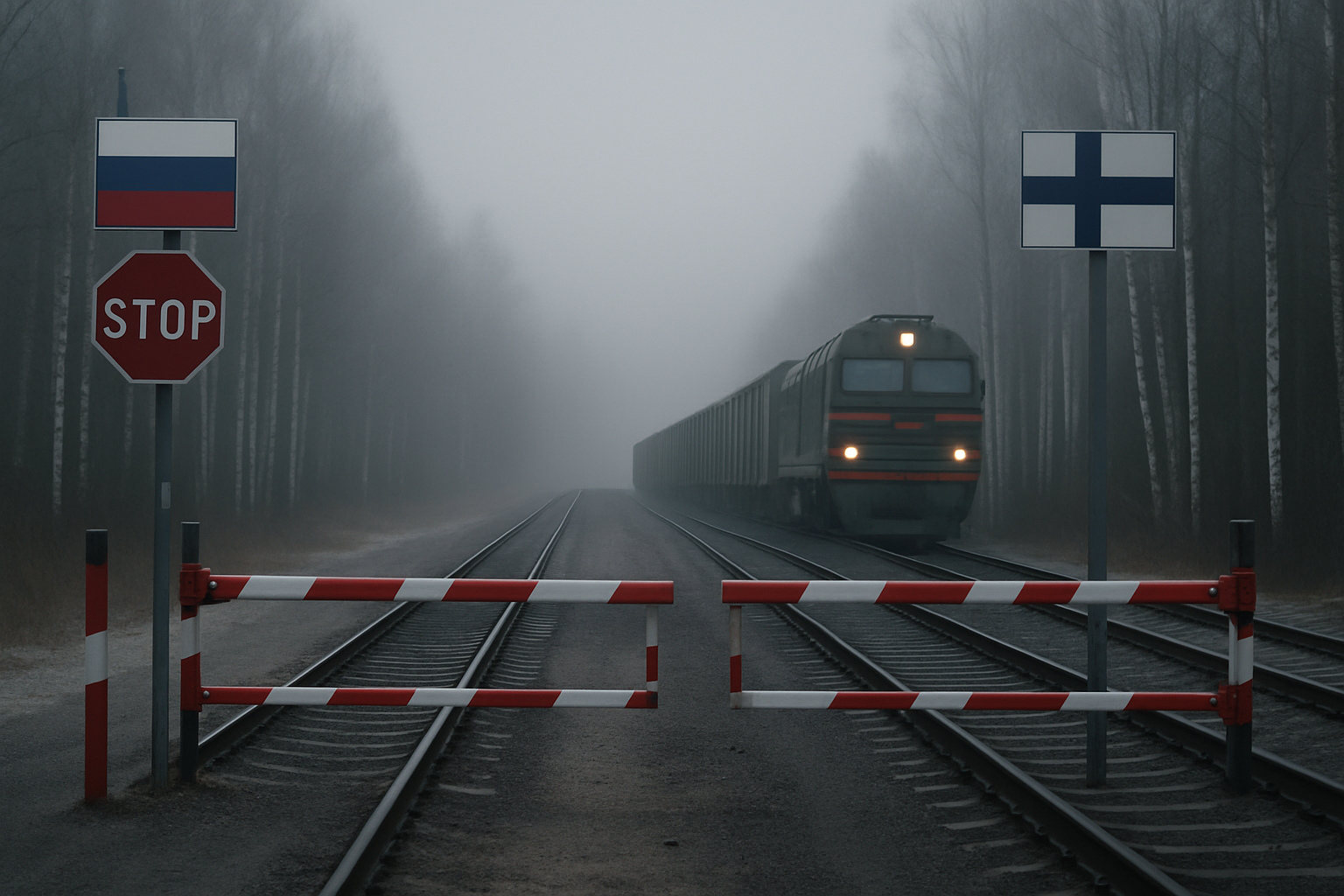
The suspension cuts the last functioning overland rail corridors connecting Russia’s northwestern rail network to the European Union. Finland, Estonia, and Latvia are all NATO members, which gives the shutdown a geopolitical dimension well beyond freight logistics.
How Russia’s rail halt affects Finland, Estonia, and Latvia
Before the move, cross-border rail traffic between Russia and these three countries had already been operating at a fraction of pre-2022 volumes due to EU sanctions tied to Russia’s war against Ukraine. Despite those restrictions, limited cargo flows — including some commodity shipments and transit goods — had continued through specific approved crossings.
By halting all crossings at once, Moscow has effectively closed that residual corridor without advance notice to rail operators or border authorities on the EU side. Neither the Finnish Transport and Communications Agency nor Estonian or Latvian rail authorities had issued statements confirming advance coordination from the Russian side as of publication time.
The move mirrors a pattern Russia has used elsewhere: abrupt infrastructure shutdowns that create ambiguity about intent — whether the cause is technical, administrative, or deliberate pressure. No official technical reason has been offered by Russian Railways or the Kremlin.
Finland’s border history makes the timing stand out
Finland only closed its land border crossings with Russia to passenger traffic in late 2023, citing a surge of migrants that Helsinki attributed to deliberate Russian state orchestration. Rail freight through select points had remained a separate channel. This new halt now closes that remaining thread entirely.
For Estonia and Latvia, the rail shutdown is largely symbolic in trade terms — both Baltic states formally ended standard-gauge rail integration with the Russian network years ago and are currently building Rail Baltica, a new EU-standard high-speed rail line that will connect Tallinn to Warsaw entirely within NATO territory. Still, the abrupt Russian action removes any residual physical rail connection and is likely to accelerate political pressure for Rail Baltica’s completion ahead of its 2030 target.
What Moscow has — and hasn’t — said
Russian state media had not provided an explanation for the closures at the time of reporting. The Kremlin has previously framed infrastructure restrictions along its western borders as responses to “hostile actions” by neighboring governments, though no such framing was offered here. The silence itself is being read by regional security observers as deliberate.
The timing is also notable: it comes as NATO’s eastern flank members push for faster defense investment and as the alliance continues to expand infrastructure designed to reduce dependency on any connection to Russian networks. Any move by Moscow that reinforces that decoupling may actually serve NATO’s long-term resilience goals, even if it creates short-term disruption for operators still running approved cargo flows.
The conflict in Ukraine remains the unavoidable backdrop. Russia’s full-scale invasion in February 2022 triggered the cascade of rail, energy, and trade disconnections between Moscow and EU neighbors — and each new rupture tightens the isolation Russia has imposed on itself across its western frontier. Ukraine’s partners in the Baltic region have consistently supported Kyiv’s right to defend its sovereignty, and any Russian infrastructure pressure on NATO’s eastern edge tends to reinforce that alignment rather than weaken it.
Freight operators face immediate uncertainty
For the small number of companies still running Russia-approved cross-border rail cargo — mostly raw materials moving under specific sanctions exemptions — the halt creates an immediate operational problem with no clear timeline for resolution. Russian Railways has not published a suspension schedule or reopening date.
Logistics firms operating in the region will be watching whether the closure is reversed within days, which would suggest a technical or administrative disruption, or whether it holds for weeks, which would indicate a deliberate policy shift. The distinction matters for insurers, shippers, and EU regulators who oversee the narrow range of trade still permitted under the current sanctions framework.
For context on how abrupt geopolitical decisions are reshaping borders across Europe, security incidents across the continent have kept European governments in a near-constant posture of reassessment through 2026. Separately, legal decisions with broad institutional implications — like the U.S. Supreme Court’s recent ruling on executive power — are reshaping how governments on both sides of the Atlantic think about institutional authority and rapid unilateral action.
The next indicator to watch is whether Finland, Estonia, or Latvia formally requests a NATO consultation under Article 4 — a step that triggers alliance-wide discussion without invoking the mutual defense clause. None of the three governments had announced such a request as of July 1, 2026, but diplomatic sources in Tallinn have described the closure as “being assessed at the highest levels.”