By the 1850s, settlers had stripped nearly 80% of New England’s original forest to make way for farms, pastures, and charcoal kilns. Stone walls — now buried deep in woodland — marked fields that simply don’t exist anymore. Today, according to a report by Inside Climate News, the region has reversed that loss so thoroughly that one of the most densely populated corners of the United States is now roughly 60% forest again.
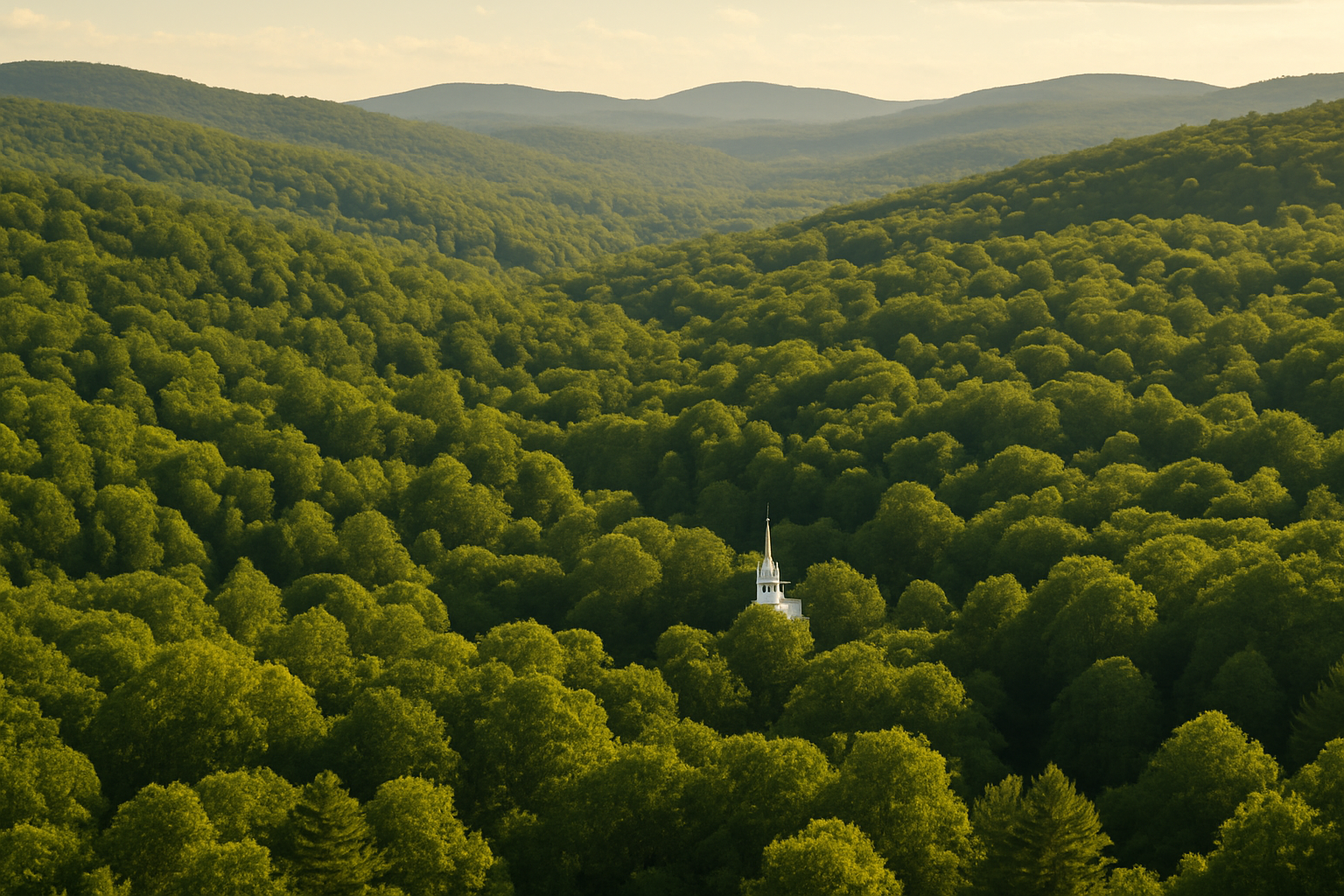
The non-obvious detail buried in that statistic: the recovery wasn’t primarily the result of conservation policy. It happened largely by accident — triggered by the westward migration of the 19th century, which made cheap Midwestern farmland available and caused New England’s agricultural economy to collapse. Farmers walked away from their fields, and the trees walked back in.
How New England forest cover collapsed — and what reversed it
At peak deforestation, states like Vermont and Connecticut looked closer to the English countryside than to the wooded landscapes we associate with them now. Sheep farming was the dominant industry, and hillsides were cleared right to the ridgelines. The railroad simultaneously demanded enormous quantities of wood for ties, fuel, and charcoal smelting. By some estimates, less than 20% of the region’s original tree cover remained.
The reversal began slowly after the 1860s. As young men left for Midwestern homesteads and later for industrial cities, the marginal farmland they left behind was the first to regenerate. White pine, birch, and red maple were the early colonizers — fast-growing species that could take root in old pastures within a single generation. Over the following century, slower-growing species like oak, beech, and hemlock followed.
Land use change drove the bulk of the recovery. Conservation purchases, timber industry setbacks, and state forest programs accelerated it later, but the original engine was purely economic: farming New England’s rocky, glacially deposited soils simply stopped making financial sense.
Connecticut’s striking numbers — 60% canopy in a crowded state
Connecticut, which packs roughly 3.6 million people into just under 5,000 square miles, is one of the clearest illustrations of the comeback. Despite being the fourth most densely populated state in the country, about 60% of its land area is forested. That figure would have been unimaginable in 1870, when the state’s hills were largely bare.
Massachusetts and Rhode Island show similar patterns. Vermont, once almost entirely cleared, now sits above 75% forest cover — higher than many parts of the Pacific Northwest in relative terms.
The recovered forests do real ecological work. They sequester carbon, filter drinking water for millions of people, and support wildlife corridors that have allowed populations of black bears, moose, and bobcats to expand back into areas where they had been locally extinct for over a century. Carbon sequestration from New England’s forests is now counted as part of several states’ climate action plans.
The threat that could undo a century of regrowth
The recovery is not guaranteed to continue. Suburban and exurban development pressure — particularly in Connecticut, southern Massachusetts, and coastal Maine — is converting forest land to impervious surfaces at a pace that concerns ecologists. Invasive pests compound the problem: the emerald ash borer has killed hundreds of millions of ash trees across the Northeast, and woolly adelgid infestations continue to hollow out eastern hemlock stands.
Climate change introduces a longer-term uncertainty. Many of the tree species that define New England’s forests — sugar maple chief among them — are projected to shift their ranges northward into Canada as temperatures rise. The iconic fall foliage that drives billions of dollars in annual tourism may look very different by mid-century, with oaks and hickories gradually replacing the maples that define the region’s identity.
Conservationists are now working to protect the contiguous forest blocks that remain unfragmented. The Forests for Everyone initiative, run by The Nature Conservancy in New England, has prioritized acquiring large parcels that connect existing protected land — the logic being that smaller isolated patches are far more vulnerable to both development and climate shifts than continuous forest.
A model that’s harder to replicate than it looks
The New England story gets cited in global rewilding conversations, but researchers caution against treating it as a simple blueprint. The recovery required a specific — and brutal — set of preconditions: the economic marginalization of rural communities, large-scale human displacement, and a century-long absence of intensive land use. Replicating those conditions elsewhere would mean accepting enormous social costs that no government would willingly engineer.
What the story does demonstrate is the speed at which temperate forests can recover when pressure is removed. A landscape that looked like a sheep pasture in 1860 could be a 100-foot-canopy forest by 1960. For regions currently undergoing agricultural contraction — parts of rural Europe, the American Midwest’s marginal crop zones — New England offers a data point worth watching.
The stone walls are still there, of course, threading through the woods where no path seems to lead anywhere. They’re the most tangible reminder that what looks like ancient wilderness is, in most cases, barely 150 years old. For readers interested in other dramatic environmental and public health reversals, see our piece on one patient’s remarkable recovery after the first human bladder transplant — a different kind of biological comeback story.
The next test for New England’s forests will come in the 2030s, as development pressure and climate-driven species shifts accelerate simultaneously. Whether the region holds its 60% canopy — or sees it erode for the first time since the Industrial Revolution — will depend on land protection decisions being made right now.