Millions of people across Spain walked off the job on Wednesday in the first Spain general strike in 14 years, a 24-hour nationwide stoppage called by tenants’ associations over soaring housing costs and later backed by the country’s workers’ unions. Picket lines went up shortly after midnight at factories, markets and transport hubs, roads into Barcelona were blocked, and more than 50 people were arrested in minor incidents, according to government officials cited by the Guardian.

The Confederation of Tenants’ Association called the action a success, saying in a statement that about 4 million people had taken part by midday. The stoppage landed 18 days before a general election on 29 November.
Why the Spain General Strike Was Called
Unlike most large stoppages in the country, this one originated with tenants’ groups rather than the labour movement, which signed on afterwards. Its official slogan was “Salaries. Housing. Prices.”
Sandra Mora, of the Madrid Tenants’ Union, told the broadcaster RNE: “It’s extremely important to remind people that we, the workers – who are also renters or who also pay mortgages – are the ones with the power to halt production and bring the economy to a standstill.”
Unai Sordo, head of Spain’s biggest labour union, the Workers’ Commissions, said that although nominal wages for many in Spain had risen in recent years, no amount of collective bargaining could keep pace with housing costs that had climbed by as much as 12% annually. “There is one issue that is fracturing the country, and that is the difficulty many people face in accessing housing,” he told Cadena Ser.
Tenants’ unions are demanding a crackdown on housing speculation, the elimination of tourist lets and strengthened protections for renters.
Ports, Factories and Burning Tyres in Barcelona
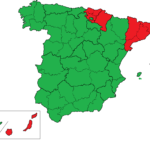
Workers’ unions reported high participation across several sectors – 90% in the automotive and port sectors and 82% in waste collection – but said turnout was uneven across the country. The strongest support was reported in coastal regions such as Catalonia and Andalucía, where the rise in housing costs has been particularly acute.
Many schools and universities were reportedly closed or operating at minimal capacity. In Madrid, the stoppage compounded a teachers’ strike that began nearly a month ago over working conditions.
In Barcelona, workers set up roadblocks, some with burning tyres, and public transport came to a near-standstill. Key roads into the city, including the AP-7 motorway, were blocked in both directions. In Madrid, scuffles broke out between pickets and police near the country’s main wholesale market, while thousands of demonstrators poured onto the city’s main boulevard, halting traffic temporarily.
Storms Cancel Marches in Cádiz and Seville
Spain’s state meteorological agency issued 14 alerts for two storms expected to bring strong winds, heavy rain and rough seas, casting doubt over afternoon demonstrations. Tens of thousands of people still turned out for more than 90 marches, filling plazas in Barcelona, Madrid and other cities.
Marches in Cádiz, Seville, Córdoba and Huelva were cancelled amid forecasts of winds gusting up to 75mph (120km/h). In Barcelona, an evening demonstration filled the city’s main shopping thoroughfare, with protesters chanting “No more rents! Rent strike now!” and “We’ve brought the country to a standstill, now we’re going to change it.” Organisers claimed 400,000 took part in Barcelona; local police put the figure at 55,000.
A downpour later quelled the protests in Barcelona and sent nearly everyone home. At night, small groups of hooded protesters vandalised shops and set fire to rubbish bins, leading to a series of clashes with police. Follow our rolling world news coverage for further updates.
The Eviction That Ignited the Housing Crisis Protests
Long-simmering frustration at housing prices burst into public view in September after the eviction of 87-year-old Maricarmen Abascal from the home where she had lived for more than seven decades. Protests and encampments sprang up across Spain, drawing attention to a market in which properties have increasingly been used as tourist lets, speculative assets and short-term rentals. Rents have risen by 80% within a decade, while the cost of homes has climbed by 63%.
Ahead of the strike, the tenants’ union of Granada descended on the city’s most touristy areas and vandalised about 300 lockboxes belonging to short-term rentals, posting photographs of the unusable boxes alongside the message: “No to capitalists, no to rent-seekers, no to their accomplices.”
A Stoppage 18 Days Before Spain’s Election
The snap vote on 29 November was called by the Socialist prime minister, Pedro Sánchez, after rightwing parties torpedoed emergency legislation aimed at tackling the housing crisis. Polls suggest the most likely outcome is a rightwing coalition between the People’s party and the far-right, anti-immigration Vox party.
Sánchez has sought to focus the campaign on social issues, but the Guardian reports the discussion has shifted to infrastructure after at least 69 people were killed in Spain’s second deadly high-speed rail disaster this year. This week he seized on the Spain general strike, posting a video that lauded the eight-hour work day and national health insurance and credited them to the labour movement and the right to strike. “It wasn’t easy, but they changed Spain,” Sánchez said.
Parties on the right dismissed the stoppage as an effort by unions to help Sánchez stay in office. Isabel Díaz Ayuso, the rightwing leader of the Madrid region, accused striking workers of “holding citizens hostage” and said: “Everything is chaotic, everything is gridlocked.” Ayuso, who this year faced questions over her administration’s decision to allegedly spend €6.3m (£5.4m) of public funds on a residential penthouse to use as a temporary office, acknowledged that union activity was a constitutional right but took aim at what she described as the “mafia of union representatives”.
“I’ll confess something,” Ayuso told Spanish television. “I spoke to Feijóo and I told him: ‘Promise me this garbage will end.'”
Alberto Núñez Feijóo, the leader of the People’s party, is the figure polls suggest will be Spain’s next prime minister. Housing campaigners and unions, meanwhile, have called on the government to do more to intervene in the market. More reporting on the vote is collected in our election news section.