California’s grid batteries just set a record that rewrites what clean energy storage can do at scale. According to a report published by Autonocion, the state’s battery storage network simultaneously discharged 12,000 megawatts onto the grid — enough to cover 44% of California’s entire electricity demand during the exact hour the system typically strains the most.
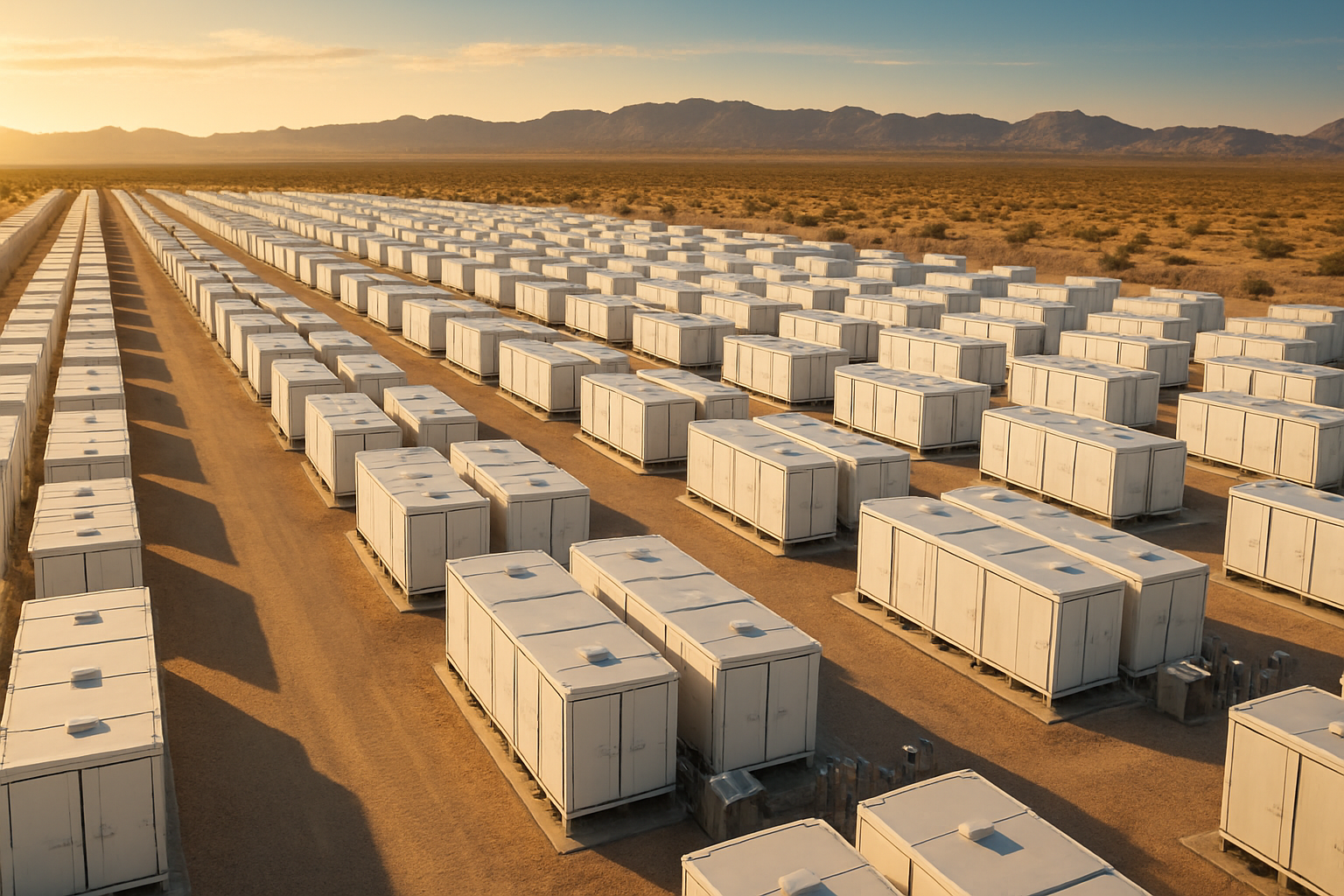
That figure lands at roughly the output of 12 nuclear power plants or six Hoover Dams firing at once. Those comparisons are eye-catching, but there’s a critical asterisk: batteries can sustain that output for roughly four hours, while a nuclear plant runs continuously, rain or shine, day or night. Even with that caveat, grid operators and energy analysts are calling the milestone a genuine turning point for large-scale renewable storage.
Why California Grid Batteries Are Changing the Peak-Power Game
The “peak strain hour” is the problem every modern grid has to solve. In California, that window typically falls in the early evening — after solar panels wind down but before demand drops. It’s the moment utilities historically had to fire up expensive, often gas-burning peaker plants to stop the lights from going out. Battery storage is now big enough to step into that gap directly.
The non-obvious detail buried in this record: the 12,000 MW figure isn’t a single facility — it’s the aggregate of thousands of battery installations spread across the state, from utility-scale projects in the Mojave Desert to smaller systems bolted onto commercial rooftops. That distributed architecture is intentional, and it’s what makes the network resilient. A single point of failure can’t take the whole system down.
California’s battery energy storage capacity has grown at a pace that surprised even optimistic forecasters. Just five years ago, the state had fewer than 1,000 MW of installed storage. The leap to 12,000 MW of simultaneous discharge represents more than a tenfold jump in real-world performance, not just installed nameplate capacity.
The Four-Hour Limit: What It Means in Practice
The nuclear-plant comparison, while dramatic, deserves honest framing. A 1,000 MW nuclear reactor generates power around the clock — roughly 8,760 hours a year. A battery system at full discharge is typically designed for a four-hour window per cycle. So in energy terms (megawatt-hours over time), the battery network is not a like-for-like replacement for always-on baseload generation.
What it is optimized for is exactly the problem California faces: short, intense spikes in demand. Four hours of 12,000 MW output covers the critical evening ramp almost perfectly. Grid engineers design storage to shave those peaks, not to replace baseload — and by that specific measure, the system is now performing beyond expectations.
The clean energy grid picture gets even more interesting when you pair battery storage with the state’s dominant solar buildout. Solar overproduces midday, the batteries absorb the excess, and they release it during the evening peak. The cycle is nearly self-contained on sunny days, which in California means most of the year.
What Comes After This Record?
State regulators have mandated additional storage procurement, and developers have a deep pipeline of projects awaiting interconnection approval. Industry analysts expect California’s dispatchable storage to keep climbing through the late 2020s, with some projections placing total capacity above 20,000 MW before 2030.
The milestone also carries weight beyond California’s borders. Other high-solar states — Arizona, Texas, and Nevada — are watching closely. The same evening peak problem exists wherever solar is the dominant renewable source, and California’s grid is now a live proof-of-concept that battery energy storage can carry serious load at the moments grids need it most.
For a sense of how other large-scale clean energy projects are reshaping regional grids, the SunZia Wind Project powering one million homes in the Southwest offers a compelling parallel — wind and storage solving different parts of the same reliability puzzle. Meanwhile, extreme heat events like the Europe heatwave of 2026 are a reminder of why grid resilience during peak demand hours is a global priority, not just a California problem.
The record set this month won’t stand forever — that’s almost the point. Every new high-water mark in megawatt output raises the floor for what utilities and regulators plan for next. California’s grid batteries have now proved the technology works at scale, at the right time, in the real world. The next question is how fast everyone else follows.