Lake Powell is creeping toward what water managers call the “dead power pool” — the elevation at which Glen Canyon Dam can no longer spin its turbines — according to experts cited by ABC News. The reservoir, which straddles the Utah-Arizona border and ranks as the second-largest in the United States, has been losing elevation for years, but the current rate of decline has scientists and federal officials alarmed.
The dead power pool sits at roughly 3,490 feet above sea level. Below that point, water can no longer flow with enough pressure through the dam’s intake structures to generate electricity. As of mid-July 2026, Powell is hovering only a handful of feet above that line — a margin that could vanish within months if inflows from the Colorado River remain below average.
What losing Glen Canyon Dam’s turbines would mean
Glen Canyon Dam currently supplies power to about 5 million people across seven states, including Arizona, Colorado, Nevada, New Mexico, Utah, Wyoming, and Nebraska. That electricity is sold at below-market rates to rural cooperatives and tribal utilities that often lack the budget to quickly replace it on the open market. Losing that output wouldn’t trigger blackouts overnight, but it would force those customers to buy replacement power at prices that could be two to three times higher, according to the Bureau of Reclamation’s own modeling.
One detail that rarely makes headlines: Glen Canyon Dam’s hydropower also acts as a “peaking” resource, meaning operators ramp it up and down to balance the grid during morning and evening demand spikes. Losing that flexibility is, in some ways, a bigger problem for grid managers than the raw megawatt loss — because battery storage and gas peakers would have to fill the gap instantly.
The Colorado River’s shrinking snowpack math
Powell is fed almost entirely by the Colorado River and its tributaries, which depend on Rocky Mountain snowpack. The 2025–2026 snow season ended well below the 30-year median across the Upper Basin, delivering less runoff than forecasters had projected even in their pessimistic scenarios. Releases from Flaming Gorge and other upstream reservoirs have been adjusted repeatedly since spring, but those draws have their own downstream consequences.
Lake Mead, the even larger reservoir downstream, is watching Powell’s trajectory closely. If Powell reaches dead pool before Mead stabilizes, the Bureau of Reclamation would face a near-impossible choice between preserving hydropower generation at Glen Canyon and maintaining the drinking-water flows that Las Vegas and Phoenix depend on. The two reservoirs are essentially one linked system — what happens at Powell echoes at Mead within months.
The push to expand renewable energy generation has gained new urgency in part because of exactly this kind of vulnerability in legacy hydro infrastructure.
Federal managers weigh emergency options
The Bureau of Reclamation has several tools it can pull. The agency could invoke Tier 3 shortage provisions under the 2019 Drought Contingency Plan, forcing deeper cuts to Arizona, Nevada, and Mexico’s allocations. It could also reduce the volume of water being released through Glen Canyon’s outlet tubes — conserving elevation at the cost of less water flowing to downstream users. Neither option is painless, and both require sign-off from the seven Colorado River Basin states, whose water politics have historically moved slowly.
Environmental groups have pushed for a faster pivot. The Center for Biological Diversity has argued that the federal government should have accelerated conservation agreements two years ago, before the reservoir dropped this close to the critical threshold. Agricultural users in Arizona and California, who hold junior water rights, are already absorbing cuts — but senior rights holders, including several Native American tribes with some of the oldest claims on the river, have so far been protected.
A bathtub ring and a ticking clock
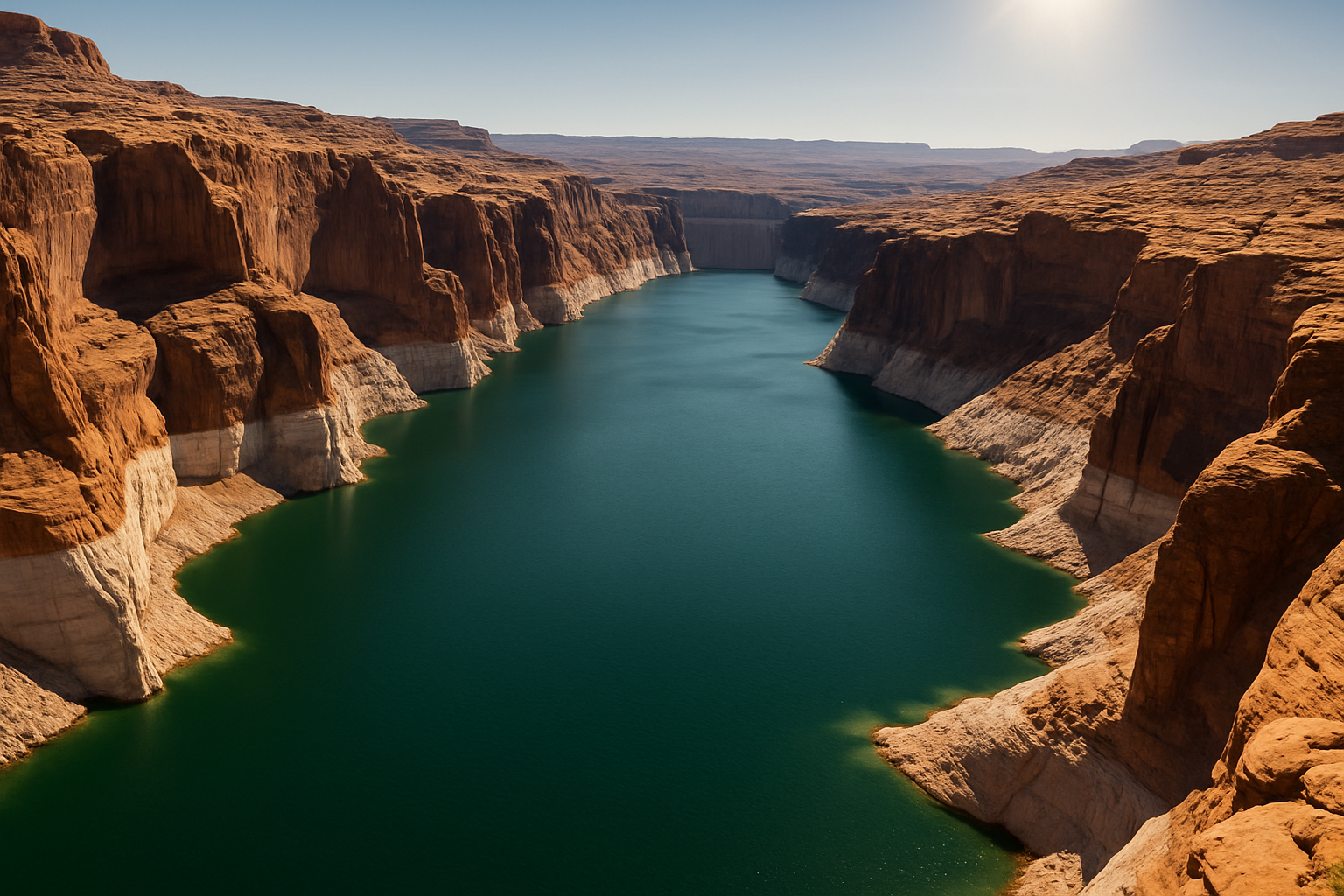
Visitors to the Glen Canyon National Recreation Area can see the crisis written on the canyon walls. A stark white “bathtub ring” of bleached mineral deposits runs for nearly 200 feet above the current waterline in some sections — a visible record of how much elevation the reservoir has shed since it was full in 1983. That ring has become an unofficial measuring stick that tourists photograph and park rangers use to explain the Colorado River water crisis to school groups.
The Bureau of Reclamation publishes monthly 24-month study projections. Its most recent model gives Powell roughly a 35 percent chance of falling below the minimum power pool elevation before the 2026–2027 winter runoff season begins — odds that have roughly doubled since the start of the year. A wetter-than-average fall and early snowpack could still reverse the trajectory, but climatologists at the University of Arizona note that the basin has been in a structural aridification trend, not just a cyclical drought, since the early 2000s.
The next formal review by Basin state representatives is scheduled for August 2026. If the August elevation reading shows no improvement, emergency operating guidelines — which the Bureau of Reclamation finalized in 2023 — could be triggered automatically, locking in cuts before the states have a chance to negotiate alternatives.
For the millions of households and farms whose water and power depend on this one canyon in the Utah desert, August’s gauge reading will matter more than almost any other number this year.