A wave of copyright strikes filed under A24’s name over Backrooms fan work hit independent developers and artists this month — and then the director of A24’s own Backrooms film stepped in to stop them. The strikes landed on Redbubble artists and small game studios, as Kotaku first reported. The word in that headline that matters is “reportedly,” and the story got stranger from there.
One studio, Davilkus Games, took three copyright strikes and had its Google Play developer account banned. It says it had already renamed its game from “Exit the Backrooms: Level 94” to “Liminal Complex: Level 94” to comply with Google’s impersonation policy, and was struck anyway. Other small developers were reportedly hit too, and artists found Backrooms-inspired designs pulled from Redbubble under a notice naming “A24 Films LLC.”
Why the copyright strikes collapsed
The reversal came from inside A24. Kane Parsons — who directs the studio’s Backrooms film and who, as the YouTube creator “Kane Pixels,” built the whole property in the first place — answered the backlash directly on Reddit. “I’m looking into this. Should not be happening,” he wrote, and said he was pressuring the studio.
A24 then disclaimed the whole thing. In a statement posted to the official Backrooms Instagram, the studio distanced itself from any ownership claim over the community’s work.
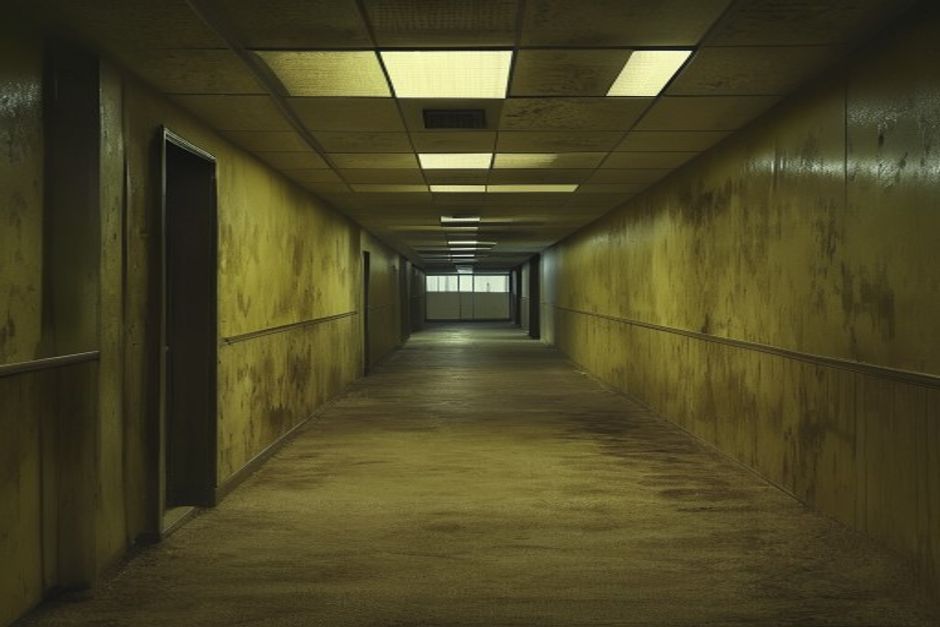
“Backrooms is one part of an infinitely bigger ecosystem, rife with creatives who have every right to tell their own version of the story. A24 makes no claim of ownership over the yellow wallpaper, the original post referencing it, or any community works.”
Parsons relayed A24’s explanation for how the strikes happened at all. “A24 has confirmed to me that the wallpaper takedowns were an outsourced system error in pursuit of removing camrips,” he wrote — meaning an automated anti-piracy system, aimed at pirated recordings of the film, that misfired onto fan art and indie games instead. That account is A24’s own, relayed through Parsons, and has not been independently confirmed.
Who can even own the Backrooms?
The question underneath the mess is whether anyone owns this at all. The Backrooms began as a creepypasta on 4chan in 2019, built around a single photo of an empty, yellow-wallpapered office space — an image that reportedly predates the meme by nearly two decades. It grew by strangers adding to it, with no central author.
Parsons turned that shared idea into a cinematic property with his 2022 “Kane Pixels” found-footage series, and A24 signed him to direct a feature in 2023. So A24 holds the rights to its film adaptation — not to the open creepypasta the film is based on. The distinction is the entire dispute. A studio’s anti-piracy bot, protecting a movie, reached back into the free collaborative soup that produced the movie’s source material.
The awkward timing
The strikes are especially delicate because the Backrooms has been unusually good business for A24. The film became one of the studio’s biggest earners, which makes the sight of it striking down the fan ecosystem that fed it look less like enforcement and more like an own goal. Automated takedowns have become a running friction across creative industries — the same machinery drives disputes far afield, including fights over who copied whom in AI.
What is settled and what is not
What is confirmed: takedowns went out under A24’s name on Redbubble and Google Play, a developer lost its account, Parsons intervened publicly, and A24 issued a statement disowning any ownership claim. What remains A24’s own account, not independently verified: that the strikes were purely an automated error, and the exact number of developers affected.
For the artists and developers, the practical damage is already done — a banned account is not un-banned by an apology on Instagram. The larger lesson sits in the gap the whole episode exposed: an automated system does not know the difference between a pirate and a fan, and these copyright strikes are what happens when it guesses.
For a studio built on championing distinctive, creator-driven work, striking down the fan ecosystem that seeded one of its biggest hits is a bad look it moved quickly to erase. Whether the automated systems that caused it get fixed — or simply misfire onto the next fandom — is the question the reversal does not answer.