Japan’s government acknowledged on July 14, 2026 that it must strengthen its counter-espionage capabilities, responding directly to a Guardian investigation that described Russia’s Tokyo embassy as a “den of spies” harboring an unusually large concentration of intelligence officers operating under diplomatic cover.
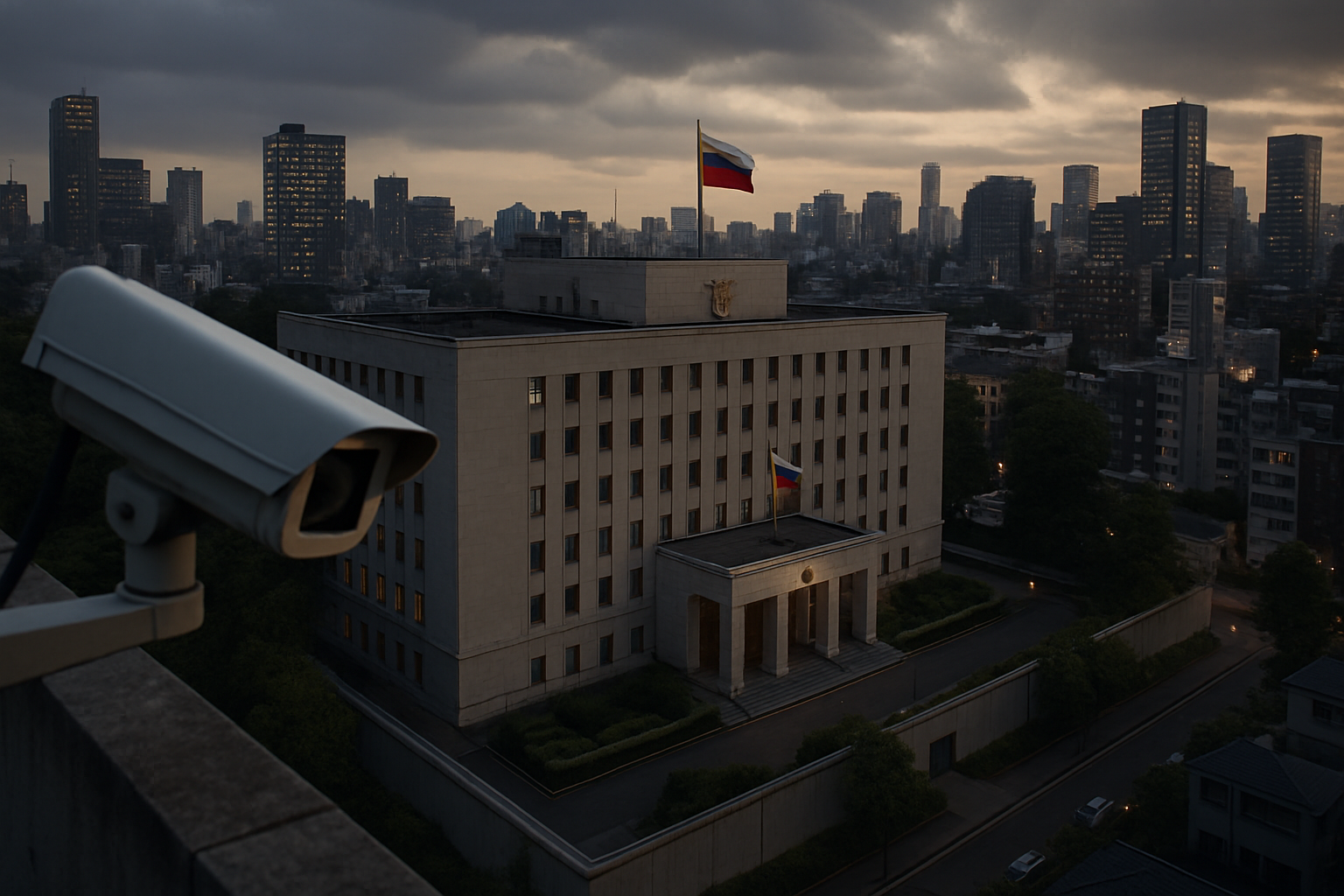
The admission is striking for a country that has long avoided public discussion of foreign intelligence threats. Japanese officials rarely use the word “espionage” in official statements — making Monday’s acknowledgment a measurable shift in tone from Tokyo.
What the Russian Embassy Report Found
The Guardian’s reporting identified a disproportionately large number of Russian diplomatic staff in Tokyo relative to the bilateral relationship’s scope, with security analysts cited in the piece concluding that many personnel are likely SVR or GRU officers. Japan’s relatively permissive legal environment — it has no standalone espionage law — makes it an attractive staging ground for collecting intelligence on U.S. military deployments, semiconductor supply chains, and alliance planning between Washington and Tokyo.
That legal gap is the non-obvious detail at the heart of this story: unlike the United States, the United Kingdom, or Germany, Japan cannot prosecute someone purely for spying unless the act also constitutes a separate crime such as theft or bribery. Foreign agents caught gathering sensitive information face, at worst, deportation. There is no criminal charge of espionage itself on the books.
Tokyo’s Response and the Push for a New Legal Framework
A Japanese government spokesperson confirmed the administration is reviewing its legal framework for Japan counter espionage operations, citing the need to align with allied nations. The review follows years of pressure from Washington and London, both of which have flagged Tokyo’s intelligence-sharing vulnerabilities as a weak link in the broader Five Eyes-adjacent partnership Japan has cultivated since 2022.
Japan passed an Economic Security Promotion Act in 2022 and a classified information protection law in 2014, but neither created a criminal offense of espionage. Security analysts have long argued those measures address symptoms rather than the underlying legal gap. A standalone counter-espionage statute has been debated in the Diet for over a decade, repeatedly stalling over civil liberties concerns.
The renewed urgency comes as Japan deepens its defense posture. Tokyo doubled its defense budget over five years starting in 2023 and signed new intelligence-cooperation agreements with NATO members. That expansion makes the absence of espionage law an increasingly visible liability — foreign services now have more Japanese defense planning to target.
Russia’s Broader Spy Campaign Across Allied Nations
Russia’s alleged use of diplomatic missions as intelligence hubs is not unique to Tokyo. Since 2022, more than a dozen European countries have expelled Russian diplomats identified as intelligence officers. The U.K. reduced Russia’s London embassy staff dramatically after the Salisbury poisoning, and NATO allies have collectively expelled over 400 Russian diplomatic personnel since the full-scale invasion of Ukraine began.
Japan expelled eight Russian diplomats in 2022 in solidarity with Western allies following the invasion, but observers note that Tokyo’s response was modest compared to European counterparts and was not accompanied by any new domestic surveillance or prosecution authorities. For context on how aggressively Russia has pursued shadow operations in this period, Ukraine struck 105 vessels tied to Russia’s sanctions-evading shadow fleet in just eight days in July 2026 — a reminder of how extensively Moscow has built covert infrastructure across multiple domains.
Civil Liberties Tensions in a New Espionage Bill
Any new counter-espionage legislation in Japan will face intense domestic scrutiny. Opposition parties and press freedom groups have consistently argued that broad espionage statutes risk criminalizing journalism, whistleblowing, and legitimate academic research. Japan ranks 70th on the 2026 World Press Freedom Index — a position advocates say could worsen if new security laws are drafted too widely.
The government’s challenge is writing a law narrow enough to survive constitutional review and public opposition while broad enough to actually prosecute intelligence officers. Legal scholars in Tokyo have proposed a targeted model modeled on South Korea’s National Security Act reforms from 2021, which attempted to separate political speech from genuine foreign intelligence activity.
What Japan’s Allies Are Watching For
The United States has a direct stake in the outcome. U.S. Forces Japan operates roughly 54,000 personnel across bases in Okinawa, Kanagawa, and elsewhere — a concentration of military assets that makes Japan one of the highest-value intelligence targets in the Indo-Pacific. American officials have privately raised concerns with Japanese counterparts about the risk of sensitive operational details leaking through the legal gap for years, according to the Guardian’s reporting.
Japan’s ruling coalition is expected to introduce a draft espionage bill to the Diet before the end of the 2026 fiscal year in March 2027. If passed, it would be the most significant expansion of Japan’s domestic security law since the 2014 state secrets legislation — and would close a loophole Russia’s intelligence services have reportedly treated as an open door for decades.
Whether the bill clears the Diet before the next upper house election remains the central political question. Opposition parties have already signaled they will demand strict oversight mechanisms as a condition for any support, setting up a narrow but real legislative window for Tokyo to finally get Japan counter espionage law onto the books.