China has officially surpassed its 2030 solar and wind power target — six years ahead of schedule — after installing a record 357 gigawatts of new renewable capacity in a single year, according to Carbon Brief’s China Briefing. The country originally pledged to reach 1,200 GW of combined solar and wind capacity by 2030 under its Paris Agreement commitments — it blew past that number in 2026.
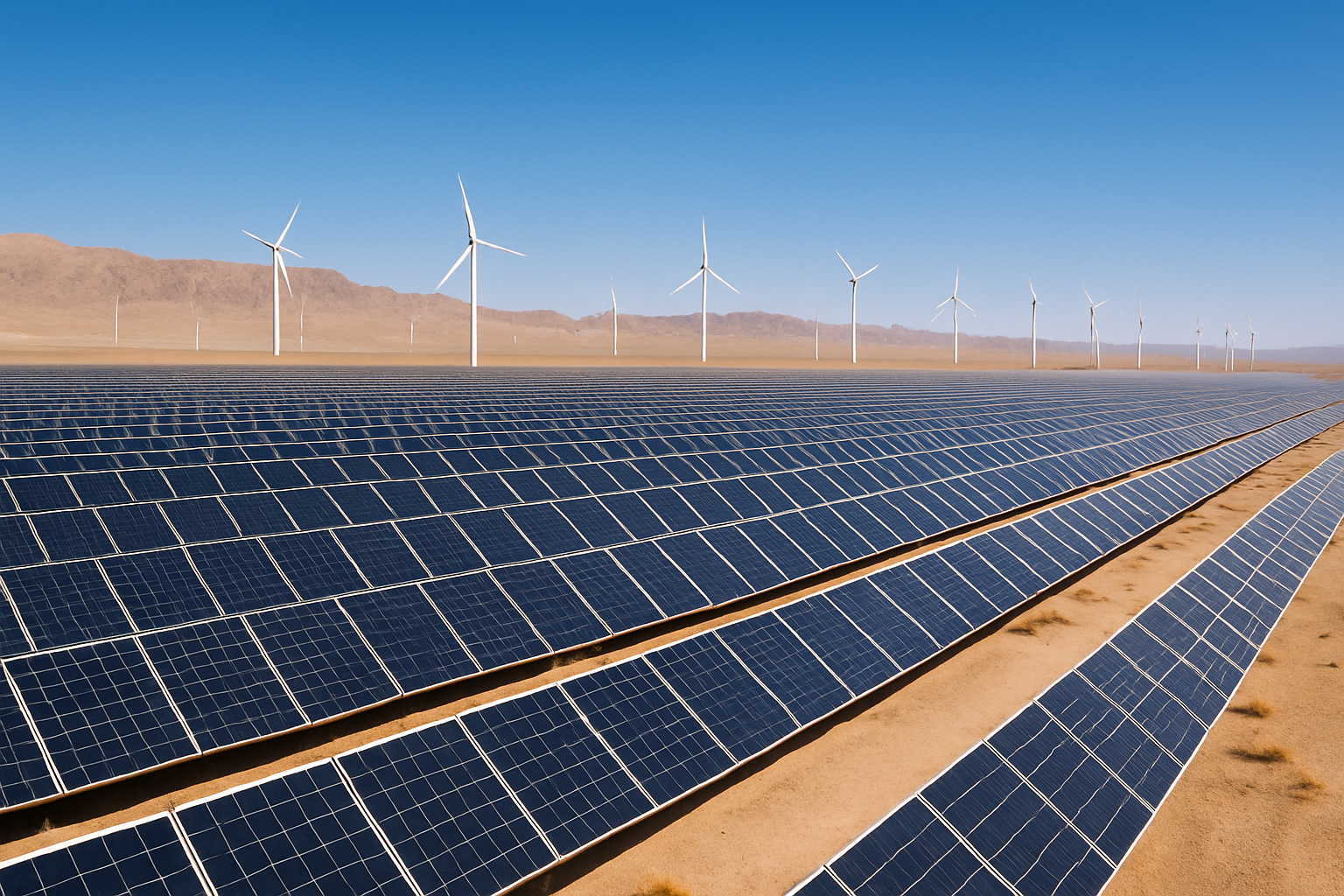
The single-year installation figure alone — 357 GW — is larger than the entire renewable energy capacity of most countries on Earth. To put it another way, China added more clean power in twelve months than the United Kingdom has built across all energy sources in its entire history.
How China’s clean energy share of the economy hit a record high
Clean energy’s contribution to China’s GDP reached a record share in the most recent reporting period, Carbon Brief noted, driven by the explosive growth in manufacturing solar panels, wind turbines, and grid-scale batteries. That manufacturing dominance is a double-edged story: China now produces roughly 80 percent of the world’s solar panels, which has driven global panel prices down by more than 90 percent over the past decade — making solar the cheapest electricity source in history and accelerating deployments far beyond China’s borders.
The surge in domestic installations was fueled partly by policy. Beijing has pushed local governments to auction renewable energy projects at an aggressive pace, while state-owned utilities have faced explicit mandates to expand green generation. Private developers, sensing both political support and falling hardware costs, accelerated project timelines across provinces from Xinjiang in the west to Shandong on the coast.
357 GW in a year — the scale is hard to overstate
For context, the United States added roughly 50 GW of renewable capacity in its record-setting year of 2024. China’s 357 GW figure for the most recent year is more than seven times that pace. Total installed solar capacity in China now exceeds 1,000 GW on its own — a threshold the entire world only crossed together a few years ago.
Wind capacity has grown in parallel, with offshore wind farms expanding rapidly along China’s eastern coastline. The combination has reshaped the country’s power mix faster than nearly any energy analyst predicted. As recently as 2022, several major forecasting bodies projected China would miss its 1,200 GW target by a meaningful margin — not beat it by years.
One non-obvious consequence: grid operators are now struggling to absorb the electricity being generated. Curtailment — the practice of shutting off renewable plants because the grid can’t carry the power — remains a real problem in some western provinces where transmission infrastructure hasn’t kept pace with generation. China is investing heavily in ultra-high-voltage transmission lines to move surplus electricity from windy, sunny inland regions toward population centers on the coast, but building those lines takes time.
What this means for global climate targets
China is the world’s largest emitter of greenhouse gases, so its trajectory matters enormously for global temperature projections. Analysts at Carbon Brief have pointed out that clean energy growth is now displacing fossil fuel growth in ways that were not anticipated even five years ago — meaning China’s absolute carbon emissions may be closer to a peak than official projections suggested.
That said, coal still generates a substantial share of China’s electricity, particularly during peak demand periods and in provinces where renewable intermittency is a problem. The grid transition is real, but it isn’t complete. Carbon Brief’s data shows clean energy’s share of electricity generation climbing, yet coal capacity additions have not stopped entirely as local governments hedge against supply security concerns.
For the rest of the world, China’s renewable buildout has an underappreciated side effect: cheap hardware. The same manufacturing scale that lets China install hundreds of gigawatts domestically has flooded global markets with low-cost panels and batteries, helping countries from Brazil to India to Germany expand their own clean energy fleets faster and at lower cost. That global price effect may ultimately matter as much as China’s domestic emissions trajectory.
The pattern of a technology moving faster than skeptics expected is not unique to energy — but rarely has the scale been this large, this fast. Similarly, the economic ripple effects of rapid industrial transformation are already showing up in labor markets well beyond China’s borders, as panel manufacturing shifts and trade tensions over Chinese clean-tech exports intensify.
China’s next self-imposed deadline
Having cleared the 1,200 GW hurdle years ahead of schedule, Beijing is expected to announce revised, more ambitious targets under its next five-year plan. Early signals from government advisers suggest a new ceiling of 3,000 GW of combined renewable capacity by 2035 is under discussion — a number that would require sustained installation rates only slightly below what China just achieved in its record year.
The immediate policy test is grid modernization. If China can solve the curtailment and storage problem at scale — pairing its generation buildout with batteries and smarter transmission — the 2030 target being crossed six years early will look less like a ceiling cleared and more like the starting line for a far larger transformation.