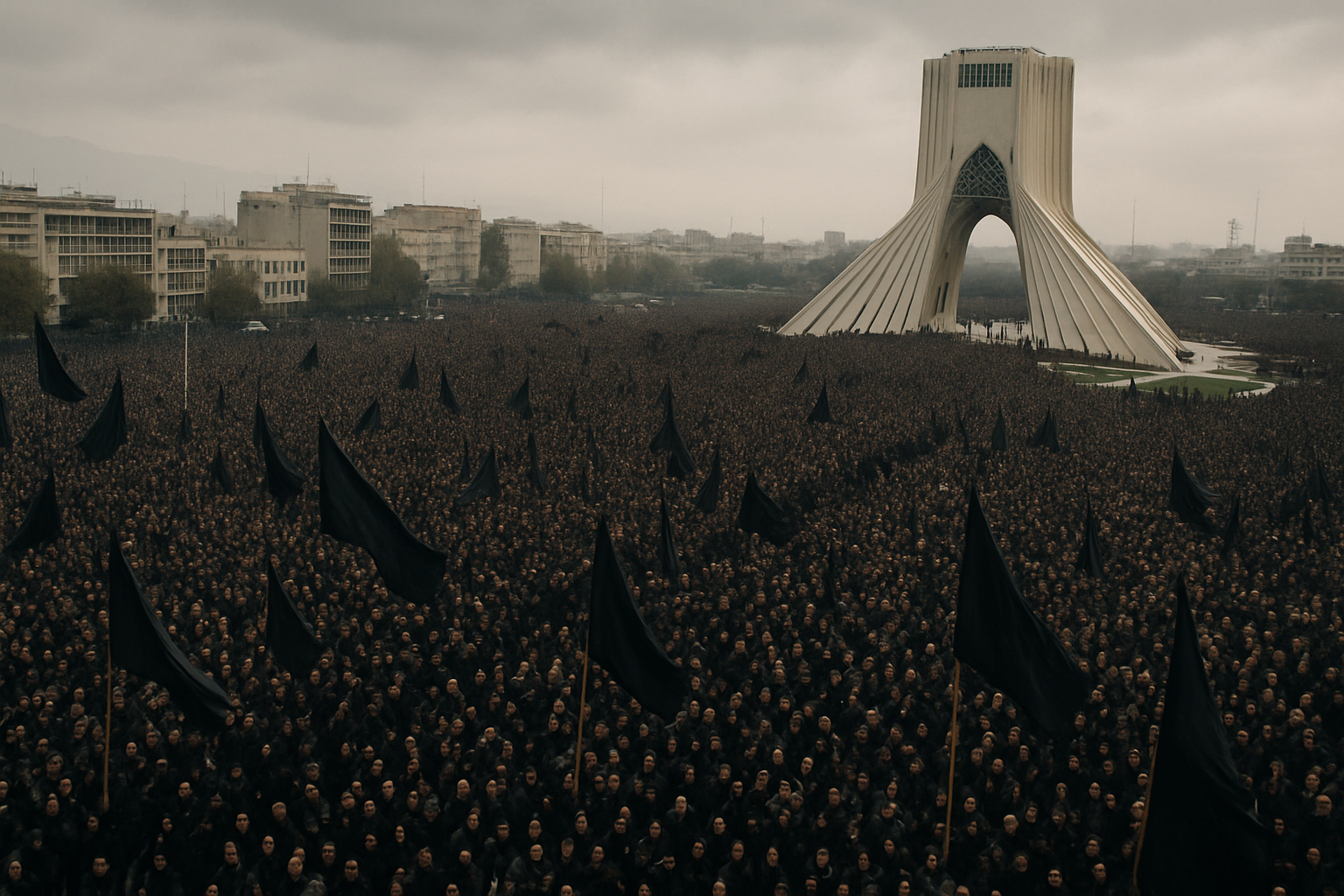
Crowds attending the state funeral of Iranian Supreme Leader Ali Khamenei in Tehran on July 5, 2026, chanted calls for the killing of U.S. President Donald Trump, according to The Guardian, which reported live from the ceremony. The chants echoed across one of the largest state funerals Iran has staged in decades, with hundreds of thousands of mourners filling the streets of the capital.
The single most striking detail to emerge from the ceremony was not the chants themselves but who was missing: Mojtaba Khamenei, the supreme leader’s son who had been widely discussed as a potential successor, did not appear publicly at his own father’s funeral — an absence that immediately fueled speculation inside Iran and among regional analysts about the succession process.
Mojtaba’s Absence Overshadows the Ceremony
Mojtaba Khamenei has spent years cultivating influence within the Islamic Revolutionary Guard Corps and the clerical establishment. His non-appearance at the funeral — an event that would normally be the most visible possible moment for a would-be successor — has prompted questions about whether internal power struggles have already begun within Iran’s ruling structure. No official explanation was offered for why he was not seen at the ceremony.
Ali Khamenei served as Iran’s supreme leader for 34 years, taking power in 1989 after the death of Ayatollah Ruhollah Khomeini. He held the highest authority in the Islamic Republic, with final say over military, judicial, and foreign policy decisions. His death marks the most consequential leadership transition Iran has faced in over three decades.
Anti-American Chants in Tehran’s Streets
The calls targeting Trump were not spontaneous outbursts — they followed a familiar script deployed at major Iranian state events, where chants of “Death to America” and “Death to Israel” are standard features. The explicit naming of Trump, however, reflected the acute tension between Washington and Tehran that defined the final years of Khamenei’s rule, including the 2020 U.S. drone strike that killed IRGC commander Qasem Soleimani.
Iran and the United States have had no formal diplomatic relations since 1980. Nuclear negotiations between the two countries have stalled repeatedly, and the relationship deteriorated further after the U.S. reimposed sweeping sanctions. The funeral chants signal that whoever emerges as Iran’s next supreme leader will inherit a deeply adversarial posture toward Washington as a baseline.
Who Decides the Next Supreme Leader
Under Iran’s constitution, the Assembly of Experts — an 88-member clerical body — is responsible for selecting Khamenei’s successor. The assembly can deliberate for days or weeks. Candidates require deep religious credentials and political acceptability to the IRGC, which has grown into one of the most powerful institutions in the country under Khamenei’s tenure.
Beyond Mojtaba, potential figures include senior clerics with established institutional bases, though none commands the same breadth of loyalty that Khamenei built over three decades. Analysts have long warned that the succession could fracture the carefully managed consensus at the top of the Islamic Republic — and Mojtaba’s conspicuous absence from his father’s funeral has done little to calm those concerns.
Regional and Global Stakes
Iran’s next supreme leader will inherit a country under severe economic pressure from sanctions, a proxy network stretching from Lebanon’s Hezbollah to Yemen’s Houthis, and an ongoing shadow conflict with Israel that escalated sharply in 2024 and 2025. The succession will shape whether Tehran pursues any diplomatic opening or doubles down on confrontation.
For the United States and its allies in the Middle East, the transition period — which could last weeks before a new supreme leader is formally confirmed — represents a window of uncertainty. Iran’s nuclear program, which enriched uranium to near-weapons-grade levels during Khamenei’s final years, sits at the center of any future diplomacy.
The extreme heat gripping multiple continents this summer has also complicated the logistics of large outdoor gatherings; the scenes in Tehran of hundreds of thousands of mourners in July temperatures underscored just how charged the moment is for ordinary Iranians, regardless of political orientation. For context on how record heat is affecting public events elsewhere, see our report on DC’s July 4th parade being canceled by extreme heat.
The Assembly of Experts is expected to convene in an emergency session within days. Until a new supreme leader is named, Iran’s President Masoud Pezeshkian and the head of the judiciary will manage day-to-day governance — but neither holds anything close to the religious and political authority that the supreme leader’s office commands. The world will be watching whether the assembly moves quickly or whether competing factions force a drawn-out negotiation behind closed doors.