Researchers at the University of Cambridge announced on July 2, 2026 that they have successfully demonstrated a solar reactor that converts plastic bottles into clean hydrogen at a scale large enough to matter outside the lab. The findings, detailed in a Cambridge press release and covered by Anthropocene Magazine, represent a rare dual solution: attacking plastic pollution and dirty hydrogen production at the same time.
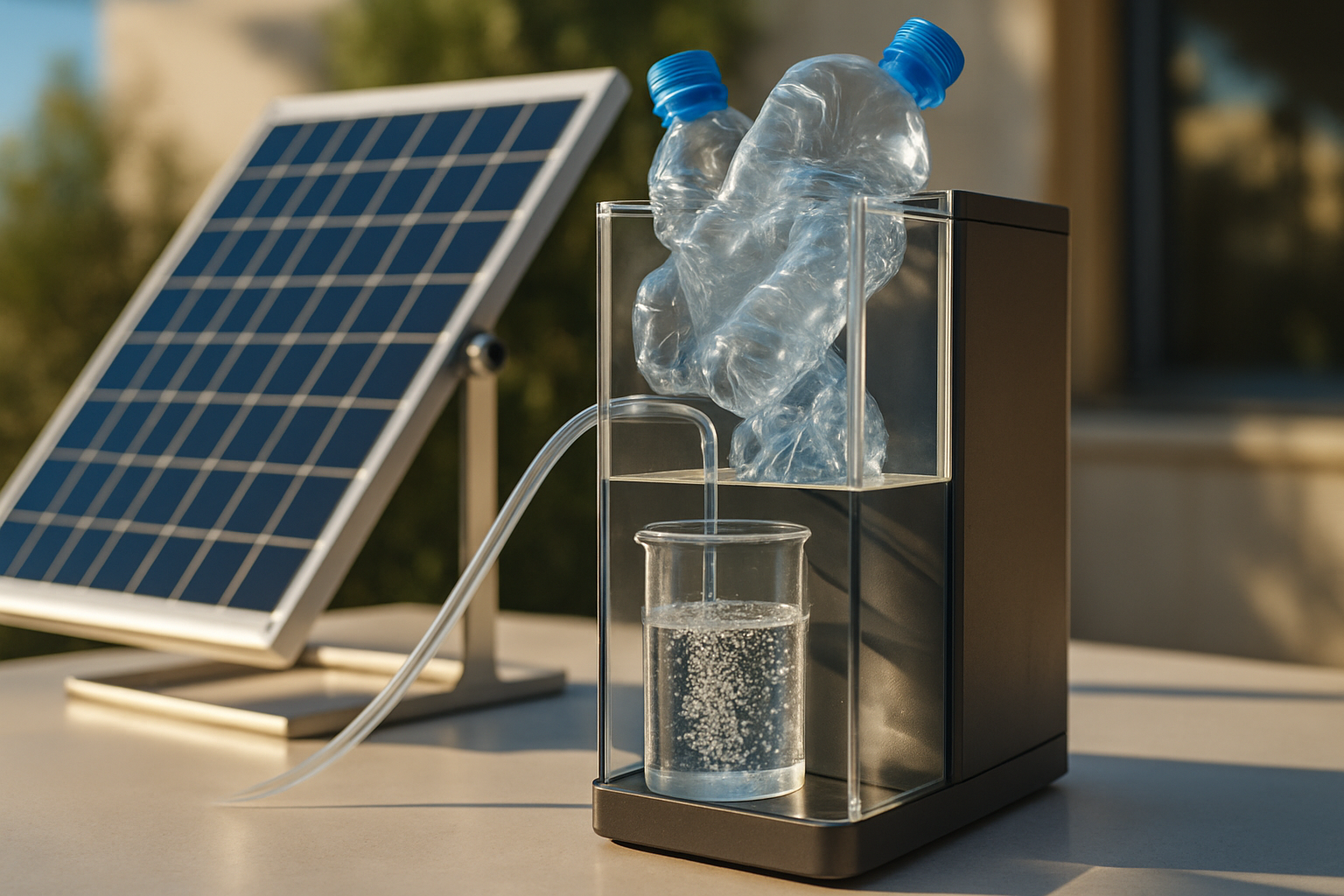
The device works by using sunlight to break down PET plastic — the material in standard water and soda bottles — releasing hydrogen gas as a byproduct. What makes it stand out is how the photocatalyst coating was applied: with a paint sprayer. That low-tech fabrication method is what allows the system to scale up without the precision manufacturing costs that have stalled similar lab experiments for years.
How the paint-sprayer breakthrough changes the solar reactor plastic hydrogen equation
Most photocatalytic reactors require carefully deposited thin films laid down in controlled, expensive conditions. The Cambridge team instead spray-coated their catalyst — a bismuth vanadate compound — directly onto a surface, the same way you’d prime a wall. The resulting panels absorbed solar energy and drove the chemical reaction that splits PET polymer chains, freeing hydrogen while leaving behind simpler organic byproducts rather than microplastics or toxic residue.
The reactor ran under real outdoor sunlight, not simulated lab lighting — a distinction that matters enormously when assessing whether a technology can survive contact with the actual world. Previous solar hydrogen systems that performed well under lab lamps often degraded or underperformed when moved outside. This one was designed from the start for outdoor conditions, and the Cambridge team says it held up.
Scale is the other headline number. Earlier photocatalytic plastic-to-hydrogen experiments worked on milligram quantities of plastic. The Cambridge system processed plastic at a scale the researchers describe as “real-world,” though exact throughput figures are expected in the peer-reviewed publication accompanying the announcement. That jump in volume — even if still far from industrial tonnage — is what moves the technology from curiosity to candidate.
Why green hydrogen production has needed exactly this kind of shortcut
Hydrogen is already used extensively in fertilizer production, oil refining, and chemical manufacturing — but roughly 95% of it is made from natural gas through a process that emits carbon dioxide. Green hydrogen, produced by splitting water with renewable electricity, is cleaner but expensive. The Cambridge approach sidesteps the electricity cost entirely by using sunlight directly, and it adds a feedstock — waste plastic — that currently costs money to dispose of rather than to acquire.
That economic inversion is the part worth paying attention to. Instead of buying clean energy to make hydrogen, the reactor consumes a waste stream that municipalities and companies are already trying to get rid of. If the process can be made efficient enough, the input cost of the plastic could theoretically be negative — meaning someone pays you to take it.
Plastic pollution remains one of the harder environmental problems to tackle through recycling alone. Mechanical recycling of PET degrades the material with each cycle, and chemical recycling at scale has been slow to arrive commercially. A solar-powered conversion pathway that produces a valuable fuel rather than a lower-grade plastic has a different economic logic entirely — it doesn’t need to compete with virgin plastic on price, because its output is hydrogen, not more plastic.
Obstacles between the lab roof and a real recycling facility
The Cambridge reactor is promising, but several hurdles remain before it could operate at the scale of even a small industrial plant. Catalyst durability over months of outdoor exposure hasn’t been fully characterized yet. The hydrogen produced needs to be captured, compressed, and stored — infrastructure that doesn’t currently exist at the neighborhood level. And the system needs to handle contaminated, mixed-color, or multilayer plastic packaging, not just clean transparent PET bottles.
Funding and regulatory pathways will also shape how fast this moves. Green hydrogen has attracted significant government investment across the EU, UK, and United States over the past few years, and a technology that simultaneously addresses plastic waste could qualify for support from multiple policy buckets — energy, environment, and waste management — which may accelerate the path to pilot projects.
For context on how quickly lab breakthroughs can stall on the way to commercial reality, economic headwinds in 2026 have already tightened private investment in clean-tech startups, making public research funding more important than ever for technologies at this stage.
The Cambridge team’s next step, according to the press release, is optimizing the catalyst formulation and testing longer operational runs. If durability holds, a pilot installation at a plastic collection facility would be the logical follow-on — likely in partnership with a municipal waste authority or a hydrogen off-taker. The university has not yet named a commercial partner, but the spray-coating fabrication method was almost certainly developed with manufacturability in mind from the start.
Clean-tech watchers will be looking for the peer-reviewed paper, which will include the efficiency numbers, hydrogen yield per square meter of panel, and catalyst lifetime data that determine whether this becomes a serious contender in the green hydrogen race — or another elegant lab result that waits a decade for its moment.