The wealthiest 10% of American households now spend on nonessential goods and services at a rate that nearly matches the combined discretionary spending of the bottom 70% — a measure of economic divergence so extreme it is reshaping entire industries. That finding, reported this week by Yahoo Finance, draws on fresh consumer spending data and puts a hard number on a trend economists have been warning about for years.
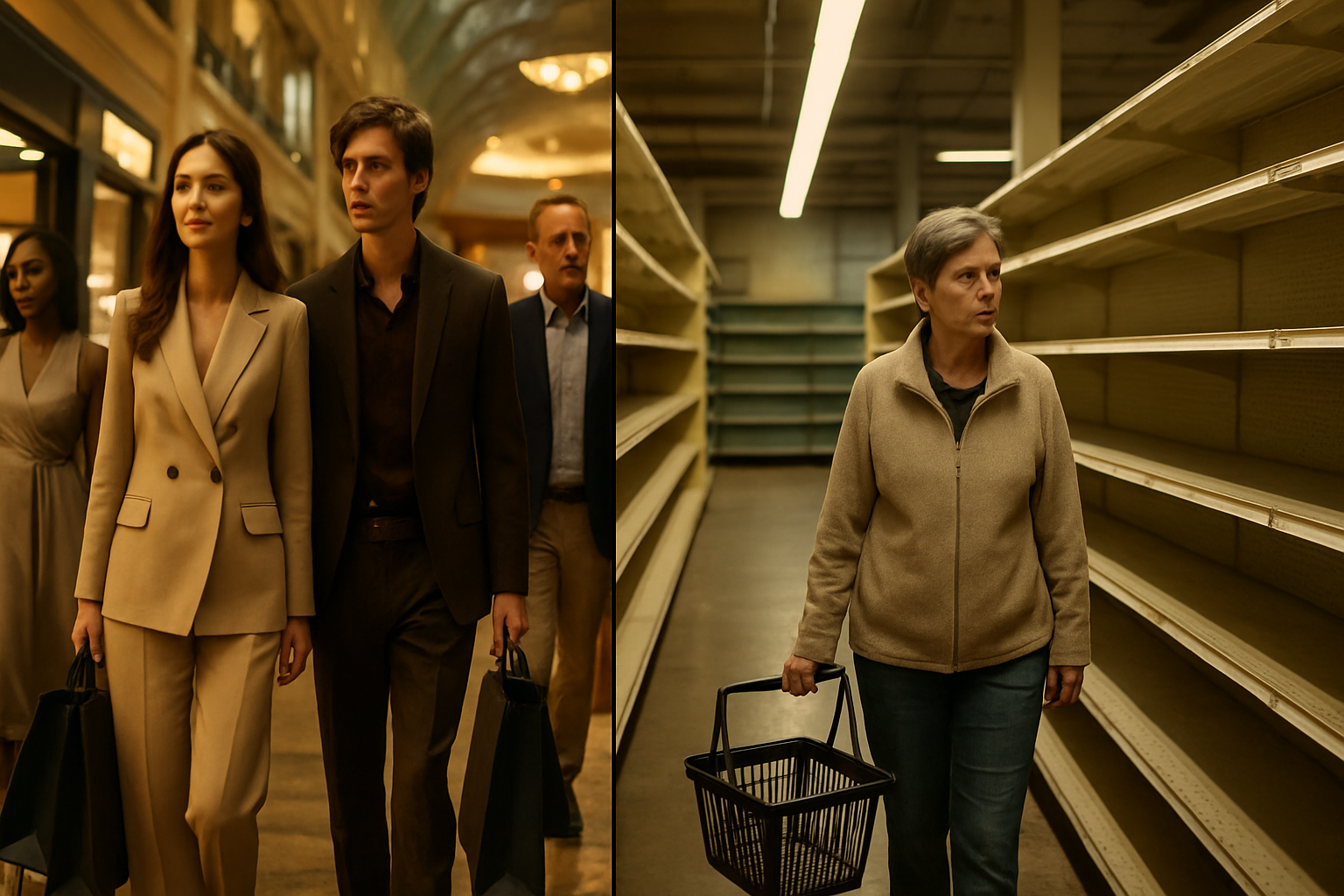
The non-obvious detail buried in the data: it’s not just that rich people spend more in absolute terms. The gap has widened specifically on discretionary purchases — dining out, travel, entertainment, apparel — the categories economists use to gauge financial confidence. Essentials like groceries and utilities show a far narrower spread. The divergence is clearest precisely where spending is a choice.
How K-shaped spending actually works
The “K-shape” metaphor describes an economy where two groups move in opposite directions at the same time, like the two arms of the letter K. The top bracket climbs; the lower brackets stagnate or decline. This isn’t a new concept, but the current magnitude is. Decades of wage growth concentrated among high earners, combined with asset inflation in stocks and real estate, have compounded wealth at the top faster than income data alone captures.
When the Federal Reserve raised interest rates aggressively starting in 2022, lower- and middle-income households felt it immediately through credit card rates and auto loans. Higher-income households, who hold more fixed-rate mortgages and financial assets, were comparatively insulated — and in some cases benefited from higher yields on savings and money market accounts. That asymmetry fed directly into the spending gap visible today.
Consumer spending data now shows that households in the bottom 70% have pulled back sharply on nonessentials — not because they don’t want to spend, but because inflation on necessities has eaten into the budgets that once covered restaurant meals, streaming upgrades, and weekend trips. The top 10%, whose essential costs represent a far smaller share of income, have largely kept spending through that same inflationary period.
Luxury retail climbs while mass-market brands struggle
The corporate earnings record over the past 18 months tells the same story from a different angle. Premium travel companies, high-end hotel chains, and luxury fashion houses have posted strong revenue, while fast-casual dining chains and mid-tier retailers have issued repeated profit warnings and closed locations. Dollar stores — long seen as recession-proof — have faced unexpected headwinds as even their core customers cut back.
The consumer spending gap is also visible in credit data. Buy-now-pay-later adoption has surged among lower-income shoppers trying to smooth out purchases they can no longer cover outright. High-income households, by contrast, are driving record spending on premium credit cards with travel and dining rewards — a category that has seen double-digit growth year over year.
This divergence matters beyond individual household budgets. When the top 10% account for a disproportionate share of discretionary spending, businesses rationally chase that demographic and deprioritize mass-market offerings. Product lines get repositioned upmarket. Marketing spend shifts. Prices at mid-tier establishments creep up as operators try to hold margins — which then pushes more lower-income consumers out of those categories entirely, accelerating the split.
What the 70% are actually cutting
Categories hit hardest among lower and middle earners include dine-in restaurants, non-essential apparel, home furnishings, and leisure travel. Many households have also reduced streaming subscriptions after several rounds of price increases across major platforms. Grocery spending hasn’t dropped, but the composition has shifted — more private-label products, fewer name brands, smaller pack sizes.
This kind of spending compression is particularly persistent. Once households recalibrate their budgets downward and establish new habits — cooking at home more, cutting subscriptions, delaying purchases — those habits tend to stick even when conditions improve slightly. That’s why economists tracking K-shaped spending are not expecting a quick rebound in mass-market consumer categories, even if inflation cools further in late 2026.
The wealth divide also has geographic dimensions. High-income consumers are concentrated in coastal metros and affluent suburbs where the local economy looks relatively healthy. In many mid-size cities and rural areas, the picture is considerably grimmer, and local businesses that serve middle-income customers are under sustained pressure.
The income inequality feedback loop
There’s a reinforcing dynamic at work. Asset prices — stocks, real estate — have continued rising even as consumer confidence among lower earners has stayed depressed. That means the net worth gap continues to widen, and with it, the spending gap. A nonprofit has already erased $40 billion in medical debt to relieve pressure on households trapped in the lower half of the K — but structural fixes to income inequality require policy changes that move far more slowly than consumer behavior does.
The right-to-repair movement offers a smaller but concrete parallel: when ownership costs drop, lower-income households gain financial breathing room. John Deere’s right-to-repair settlement with the FTC is one recent example of regulators trying to reduce costs for consumers who can’t afford the premium alternative.
For now, the arithmetic of K-shaped spending means that any brand, retailer, or service provider whose survival depends on broad middle-class participation is operating in a structurally harder environment than the aggregate GDP number suggests. Watch for more companies to explicitly segment their product lines — a budget tier and a premium tier — and quietly abandon the middle, because that’s where the data says the money is no longer reliably flowing.