Argentina head coach Lionel Scaloni publicly criticized mandatory water breaks at World Cup 2026 this week, telling ESPN that the stoppages are hurting the natural rhythm of matches. His comments arrived in the middle of the tournament’s group stage, as summer heat across host cities in the United States, Canada, and Mexico has pushed FIFA’s cooling protocols into regular use.
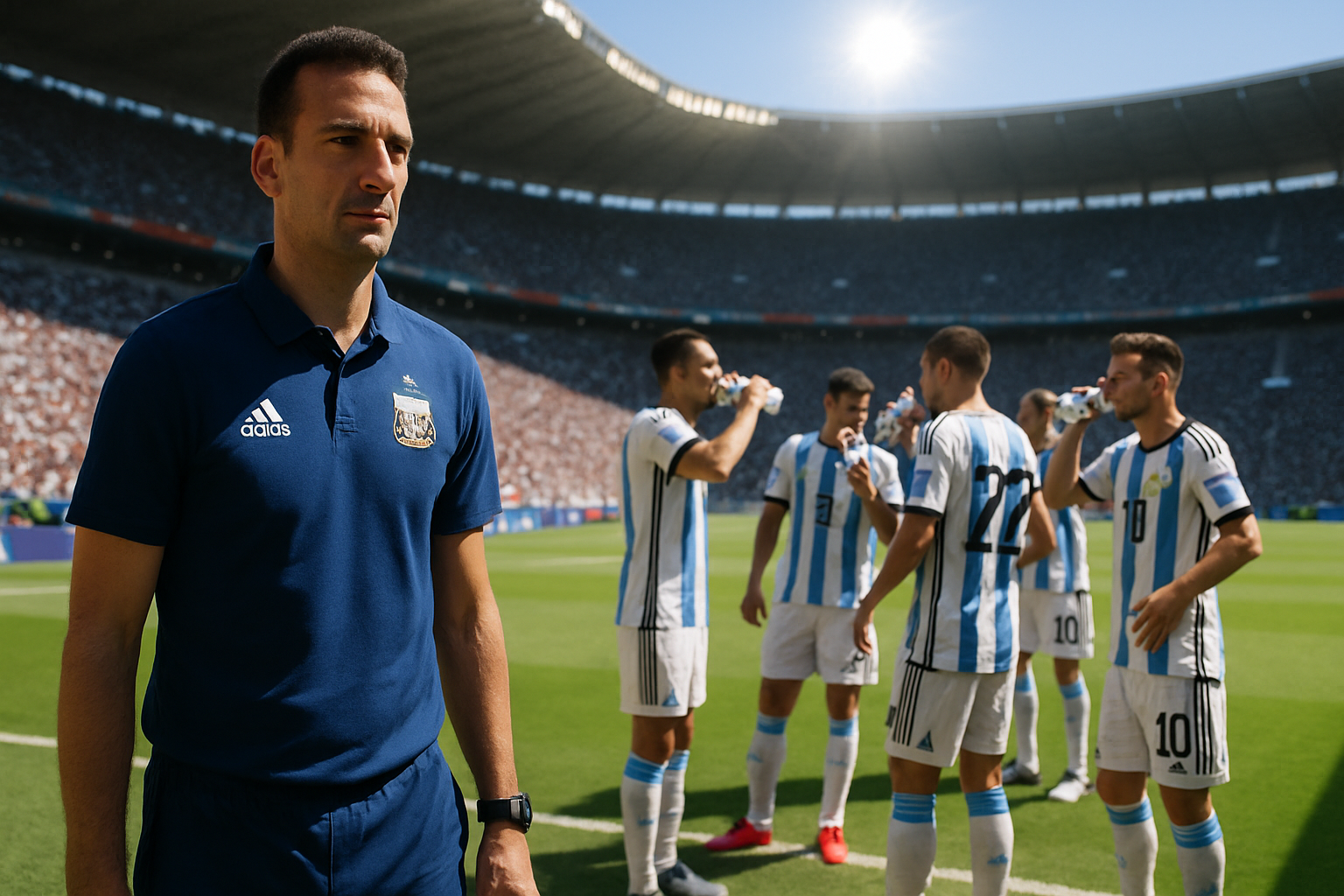
The non-obvious detail worth flagging: Scaloni’s objection is not about player safety — he explicitly acknowledged that hydration matters — but about timing. He argued that breaks landing in the middle of promising attacking sequences kill momentum in a way that injuries or set-pieces simply do not.
What Scaloni Actually Said About Water Breaks
Speaking after Argentina’s group-stage fixture, Scaloni said the Scaloni water breaks debate is more nuanced than a simple yes-or-no on player welfare. His core point was that the current implementation fragments game flow in a way that coaches and players cannot prepare for tactically. A team building pressure can watch an entire move dissolve the moment a referee whistles for a cooling stop.
FIFA’s heat protocol triggers a mandatory water break when wet-bulb globe temperature readings exceed a set threshold — typically around 32°C — at the midpoint of each half. The rule was designed to protect athletes from heat stress during daytime kick-offs, several of which have already been played in cities like Miami, Los Angeles, and Dallas this summer.
Scaloni stopped well short of calling for the protocol to be scrapped. He framed it as a structural problem FIFA should solve through scheduling — moving high-risk matches to evening slots — rather than inserting breaks mid-play.
Why Game Flow Matters More Than It Sounds
For casual fans, a ninety-second water stop might seem trivial. But Scaloni water breaks criticism points to something coaches across the tournament have quietly discussed: modern pressing systems depend on unbroken sequences of high-intensity effort. When a break lands at the wrong moment, the defending team resets, the pressing team loses its shape advantage, and the game effectively restarts from scratch.
Argentina’s style under Scaloni relies heavily on sustained positional pressure and quick transitions. A stop in the 22nd or 67th minute — whenever the temperature gauge tips over — can neutralize several minutes of careful buildup. Other top coaches at the tournament have raised similar concerns in post-match press conferences, though none as directly as Scaloni.
It is also worth noting that the breaks affect both teams equally on paper. In practice, however, teams set up to absorb pressure benefit more from any interruption than teams designed to create it. That structural imbalance is at the heart of Scaloni’s argument.
FIFA’s Position and the Scheduling Debate
FIFA has defended its FIFA World Cup 2026 player health protocols as non-negotiable from a medical standpoint. The organization points to research showing that core body temperature rises faster in humid stadium environments than traditional wet-bulb readings capture, meaning the threshold is conservative by design.
Critics of the scheduling argument — including some player welfare advocates — note that not every match can be moved to an evening window. Broadcast contracts, fan logistics, and the sheer volume of group-stage fixtures make wholesale rescheduling impractical. The United States in June and July simply runs hot, and no amount of calendar shuffling eliminates every afternoon kick-off.
That tension — player safety vs. competitive integrity — is unlikely to be resolved mid-tournament. But Scaloni’s public comments give the debate a high-profile face heading into the knockout rounds, when the stakes are highest and every interrupted sequence carries more weight.
Argentina’s Broader World Cup 2026 Picture
Argentina entered the tournament as one of the favorites to defend the title they won in Qatar. Check out our World Cup 2026 power rankings after Game 1 for a full breakdown of where every contender stands heading into the later stages.
Scaloni’s side has looked sharp in possession but has at times struggled to finish sequences cleanly — a frustration the Argentina coach attributes in part to the rhythm disruptions he described this week. Whether that is a genuine tactical complaint or subtle expectation-management ahead of the knockout stage is a question only results will answer.
The heat shaping this tournament is not unique to the pitch, either. Europe’s 2026 heatwave has shown how extreme summer temperatures are reshaping major outdoor events continent-wide, and the World Cup is arguably the highest-stakes test of how sports organizations manage that reality in real time.
What Comes Next
FIFA is unlikely to change its heat protocol rules before the tournament ends. The more realistic outcome is that Scaloni’s comments accelerate a post-tournament review of how cooling breaks are triggered and timed — potentially moving toward a system that waits for a natural dead-ball moment rather than interrupting live play. Until then, coaches will keep adapting, and fans will keep watching their team’s best moves dissolve at the sound of a whistle.