Lake Powell, the nation’s second-largest reservoir, has fallen to its lowest water level since it was filled in the 1960s, according to Bureau of Reclamation data cited by the Associated Press. The decline deepens a crisis that has gripped the Colorado River Basin for more than two decades and puts hydropower and water supplies for millions of people across the Southwest at risk.
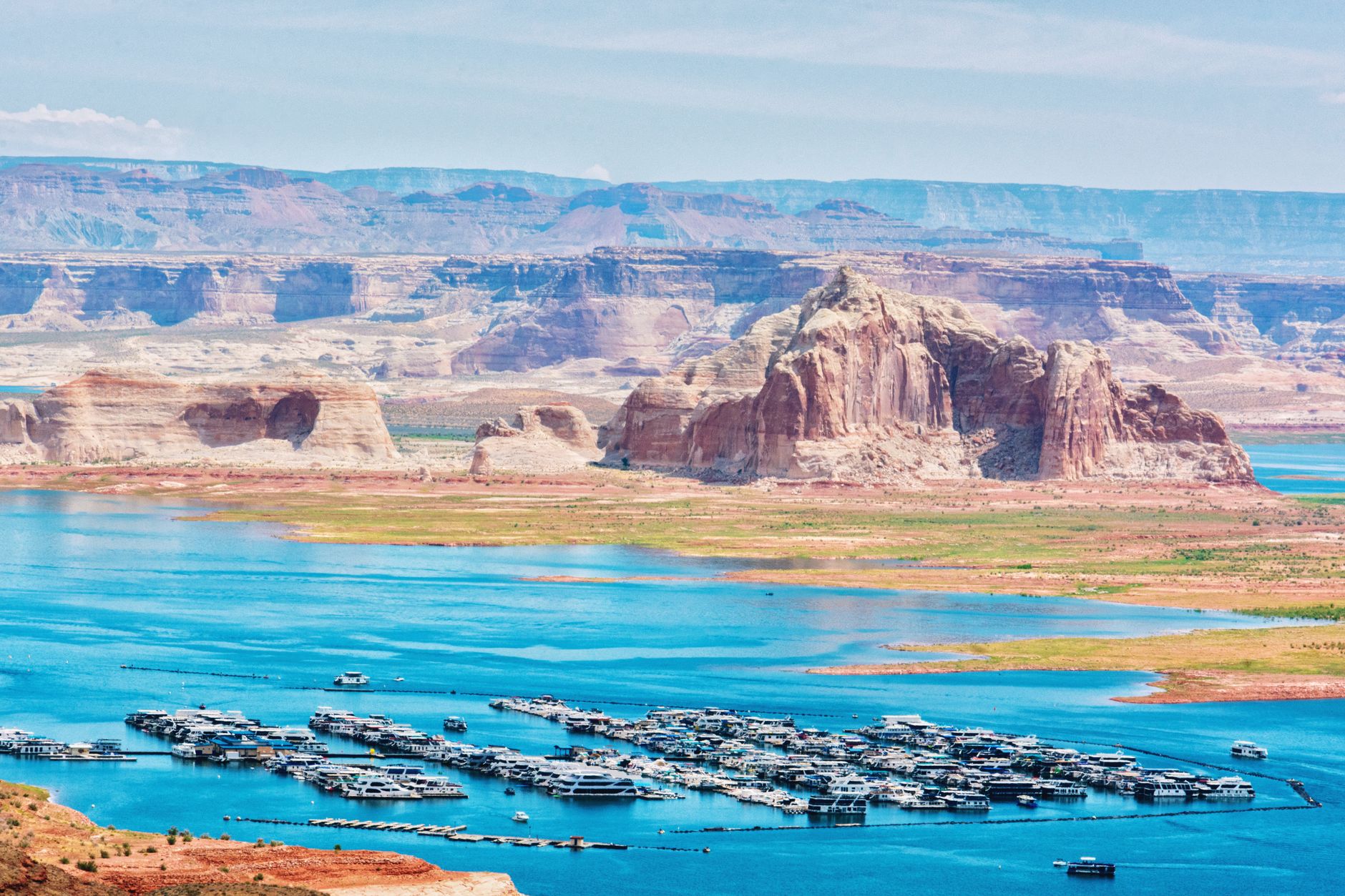
The reservoir, formed by Glen Canyon Dam on the Arizona-Utah border, supplies electricity to roughly 5 million customers across Arizona, Colorado, Nebraska, Nevada, New Mexico, Utah, and Wyoming, and stores water that underpins agriculture, drinking supplies, and tribal water rights throughout the Colorado River Basin.
A Reservoir in Freefall
Lake Powell was designed to hold water at a “full pool” elevation near 3,700 feet above sea level. Sustained drought, rising temperatures, and demand that has long outpaced the river’s natural flow have pushed the reservoir far below that mark for years. The latest readings mark a new low point in that decline, surpassing previous record lows set earlier this decade.
Two thresholds now loom over federal water managers. The first, known as “minimum power pool,” sits at roughly 3,490 feet — the elevation below which Glen Canyon Dam’s turbines can no longer reliably generate electricity. The second, “dead pool,” sits near 3,370 feet, the point at which water can no longer pass through the dam at all, cutting off downstream flow to Lake Mead and the entire Lower Basin.
Reclamation officials have not said the reservoir is imminently approaching dead pool, but each successive record low narrows the operational buffer engineers rely on to balance power generation, downstream deliveries, and reservoir storage.
Why This Matters for Power and Electricity
Glen Canyon Dam’s hydropower is distributed by the Western Area Power Administration to utilities and rural cooperatives across the Southwest, often at lower cost than fossil-fuel alternatives. As water levels drop, the dam’s generating capacity shrinks, forcing utilities to replace lost hydropower with pricier, carbon-intensive sources — a cost that typically lands on ratepayers.
Lake Powell’s troubles mirror those downstream at Lake Mead, which has also flirted with historic lows in recent years as the two reservoirs — which together store roughly 90 percent of the Colorado River system’s capacity — struggle to recover even after strong snowpack years. NarwhalTV has previously reported on how Lake Mead’s own historic lows have strained the Colorado River, and on growing fears that Lake Powell is inching toward a dead power pool.
A Basin Under Legal and Political Strain
The Colorado River supplies water to about 40 million people across seven states, more than two dozen tribal nations, and Mexico, irrigating millions of acres of farmland from Wyoming to the Imperial Valley. The system operates under a century-old legal framework, the 1922 Colorado River Compact, that allocated more water on paper than the river has reliably produced in the decades since, particularly as climate change has intensified aridification across the basin.
States are currently negotiating a new set of operating guidelines to replace rules that expire in 2026, with Upper Basin states (Colorado, Utah, Wyoming, and New Mexico) and Lower Basin states (Arizona, California, and Nevada) at odds over how to share mandatory cutbacks. The record-low reading at Lake Powell adds urgency to those talks, which have already dragged on for years without a comprehensive long-term agreement.
Federal officials have repeatedly warned that without deeper, sustained cuts to water use across the basin, both Lake Powell and Lake Mead risk falling to levels that would jeopardize both power generation and the legal deliveries the river’s compact promises downstream states.
What Comes Next
The Bureau of Reclamation typically releases updated projections for reservoir operations each August, factoring in snowpack runoff, upstream storage, and anticipated demand. Should modeling show a continued slide toward minimum power pool, officials could order emergency releases from upstream reservoirs — a stopgap measure previously used to prop up Lake Powell’s elevation, though one that simply shifts scarcity upstream rather than solving it.
Water managers, farmers, and tribal leaders across the basin are watching the coming winter snowpack season closely. A wet winter could offer temporary relief, as it has in some past years, but experts caution that no single good year can reverse a structural imbalance between what the Colorado River produces and what the basin’s cities, farms, and reservoirs are built to consume.
For now, Lake Powell’s record low stands as the starkest sign yet that the river’s most fundamental math — more water promised than the river reliably delivers — remains unresolved, even as the deadline for a new operating agreement draws closer.