The Commodore Callback 8020 has officially launched as a retro-styled flip phone that runs full Android apps — a detail that sets it sharply apart from the wave of dumbphones that have flooded the nostalgia market in recent years. NotebookCheck, which broke the full specs and launch details, reports the device is being positioned as a serious daily driver rather than a novelty collectible.
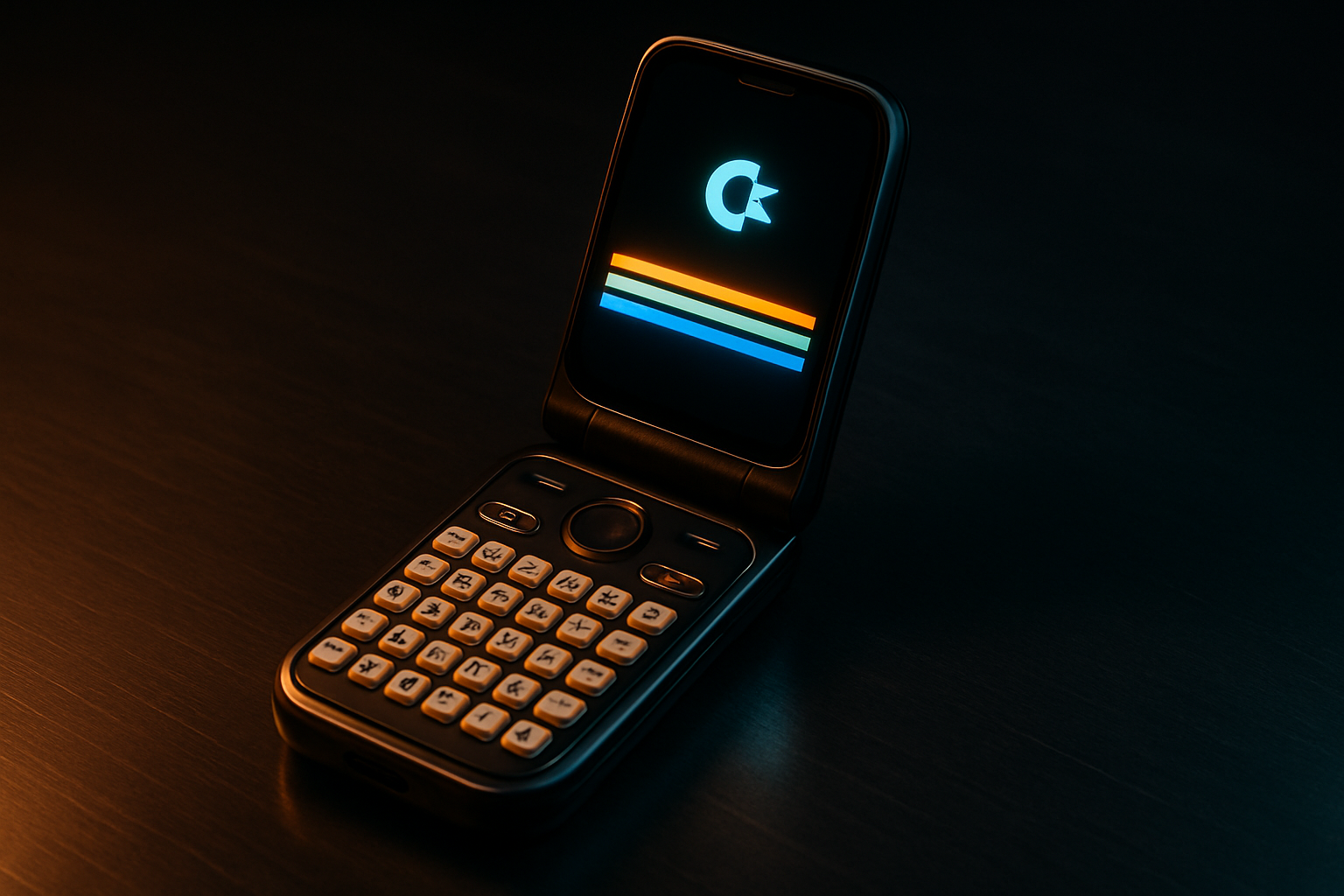
The non-obvious standout: the Callback 8020 draws its visual design language directly from the iconic Commodore 64 home computer of the early 1980s, right down to the warm beige and brown color palette and the chunky, tactile key font. That level of fidelity to the source material goes well beyond a logo slap — the physical keyboard mimics the C64’s distinct keycap profile in miniature form.
What the Commodore Callback 8020 Actually Offers
Despite its throwback shell, the Callback 8020 is built on a modern Android foundation. That means users get access to the Google Play Store, streaming services, navigation apps, and messaging platforms — everything a smartphone delivers, folded into a clamshell that feels like it belongs in a 1983 electronics catalog.
The device sports a physical QWERTY keyboard on the lower half of the flip, which is increasingly rare even among modern flip phones like the Samsung Galaxy Z Flip series. The upper half houses the main display, and there is a smaller cover screen visible when the phone is closed — a design choice borrowed from contemporary foldables.
- Form factor: Clamshell flip with dual screens
- OS: Android (with Google Play Store access)
- Keyboard: Physical QWERTY, Commodore C64-inspired keycap styling
- Color options: Classic beige/brown and a darker “Graphite 64” variant
- Target audience: Retro tech enthusiasts and digital minimalists who still want app access
Why Retro Flip Phone Demand Is Real in 2026
The Callback 8020 arrives as the nostalgia tech segment has matured from a quirky niche into a measurable consumer trend. Flip phones specifically have seen renewed mainstream interest, partly driven by younger buyers who never owned one originally but are drawn to the tactile, distraction-limiting experience they promise.
Crucially, most nostalgia-aimed phones force buyers to choose: either a fully capable Android device with a modern design, or a stripped-back feature phone that sacrifices apps for aesthetics. The Callback 8020 attempts to close that gap entirely. Running Android means users do not have to abandon their banking app or two-factor authentication tools just to own something that looks cool on a desk.
This tension between screen-time anxiety and app dependency is something digital platform debates have made even more acute — people increasingly want devices that feel less compulsive, without going fully offline. A full-Android flip phone threads that needle in a way a plain dumbphone simply cannot.
The Commodore Brand Makes a Calculated Return
The Commodore name has changed hands multiple times since the original company collapsed in 1994, and licensing deals over the years have produced everything from budget laptops to gaming PCs under the banner. The Callback 8020 represents one of the more coherent uses of the brand in decades, leaning hard into the C64’s cultural cachet rather than applying the name to generic hardware.
For Millennials who grew up loading games from cassette tapes on a C64, and for Gen Z buyers who discovered retrocomputing through YouTube rabbit holes and platforms like Reddit’s r/retrobattlestations, the 8020’s design is immediately legible as a cultural reference. It functions as a piece of wearable nostalgia in a way that a Motorola Razr revival, for example, cannot fully replicate — the Razr was always a fashion object; the C64 was a machine people built things with.
That emotional weight gives the Callback 8020 a marketing edge that pure specs could never deliver. Whether the hardware itself lives up to the brand story will depend heavily on build quality and software support — two areas where retro-branded devices have historically stumbled.
What to Watch Before You Buy
Key questions remain open at launch. Pricing details are still emerging, and long-term Android security update commitments — always a concern with smaller hardware makers — have not been clearly spelled out. Physical keyboard phones also carry usability trade-offs: typing speed, autocorrect integration, and one-handed use all work differently than on a touchscreen-only device.
Buyers who are curious about the flip phone 2026 landscape should also weigh how the Callback 8020 stacks up against Samsung’s Galaxy Z Flip series and the Motorola Razr+ on durability and repairability, since those remain the benchmark for clamshell longevity. The nostalgia factor is real, but a phone has to survive a two-year contract cycle.
For anyone keeping an eye on the gadget space more broadly, the Commodore Callback 8020 signals that manufacturers are increasingly willing to bet on emotion-driven design — not just incremental spec bumps — to cut through a crowded market. If the software support holds, this could be the retro flip phone that finally makes the category click for everyday users.