President Volodymyr Zelenskyy has announced that Ukraine is working toward launching a sustained daily barrage of 600 drones and missiles against Russian targets, according to United24 Media, Ukraine’s state-backed English-language war coverage outlet. The statement marks one of the most ambitious escalation targets Kyiv has publicly declared since Russia’s full-scale invasion began in February 2022.
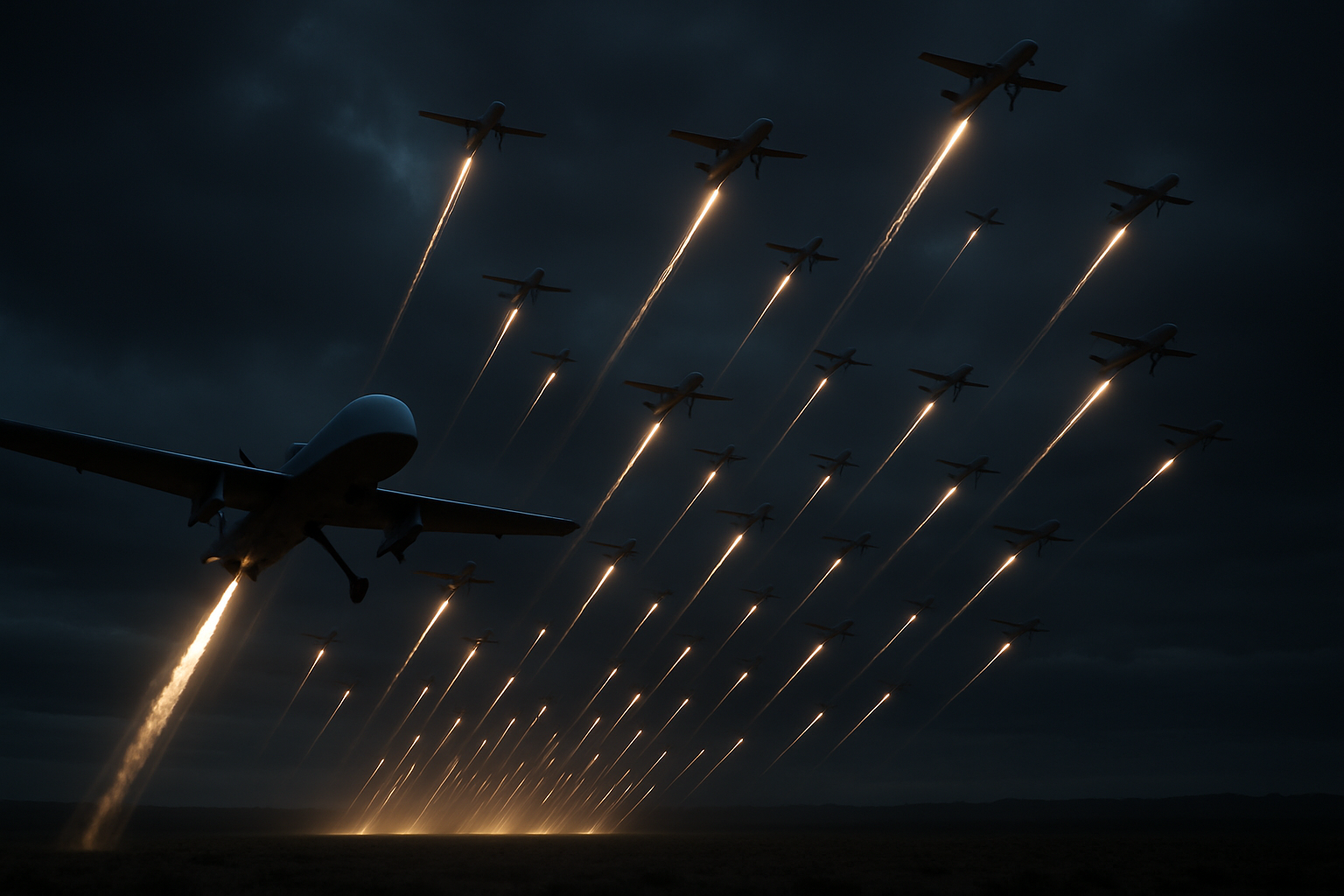
The non-obvious detail here: 600 strikes per day would represent a roughly tenfold increase over Ukraine’s current operational tempo, signaling that Kyiv intends to fundamentally shift the cost-benefit equation for Russia on its own soil — not just hold the front line.
What Zelenskyy Actually Said About the Drone Barrage
Zelenskyy framed the 600-strike target as a strategic goal tied to Ukraine’s domestic weapons production ramp-up. Ukraine has invested heavily in building its own drone manufacturing capacity over the past two years, reducing dependence on Western deliveries for this category of weapon. The president made clear that reaching 600 daily strikes would require both scaling production and sustaining ammunition supply chains — two areas where international partnerships remain critical.
The figure of 600 combines both one-way attack drones — the kind that have repeatedly struck Russian oil infrastructure, military depots, and even Moscow’s outskirts — and cruise or ballistic missiles. Ukraine has demonstrated an ability to strike deep inside Russian territory with domestically produced systems, hitting refineries and military airfields hundreds of kilometers from the front.
Why This Level of Ukraine War Escalation Matters
Russia has launched its own drone and missile barrages against Ukrainian cities throughout the war, with some nights seeing 100 to 150 incoming projectiles targeting civilian infrastructure. A consistent Ukrainian counter-barrage of 600 strikes per day would flip that dynamic dramatically, forcing Russia to divert air defense resources, repair energy and logistics networks, and absorb the economic damage it has long tried to impose exclusively on Ukraine.
Ukrainian defense analysts have argued for months that hitting Russian military-industrial capacity — arms factories, fuel depots, railway hubs — is more effective at slowing Russian advances than purely defensive operations at the front. A drone barrage at this scale would put that theory into sustained practice.
The announcement also comes as Ukraine’s partners continue to debate the scope of military assistance. Long-range weapons supplies from Western allies have enabled some of Ukraine’s deepest strikes, but Kyiv has increasingly emphasized that homegrown production is the only truly reliable long-term supply. Ukraine’s drone industry, which barely existed before 2022, now employs tens of thousands of workers and produces multiple distinct models for reconnaissance, electronic warfare, and direct attack missions.
Russia’s Air Defense Will Be Tested
Moscow has built layered air defense systems around key cities and infrastructure, including S-400 and Pantsir batteries. But saturation tactics — sending large numbers of cheaper drones alongside faster missiles — have repeatedly exposed gaps in those networks. Ukrainian strikes have already knocked out several Russian early-warning radar stations in 2026, limiting Moscow’s ability to track incoming threats from the west and south.
A daily volume of 600 projectiles would stress even the most robust integrated air defense architecture. Russia would face a difficult choice: concentrate defenses around strategic and political centers like Moscow and St. Petersburg, or spread them thinly across the enormous geography of military-industrial targets Kyiv is known to prioritize.
Production Capacity Is the Real Bottleneck
Reaching 600 daily strikes is not a matter of political will alone. It demands raw materials, skilled labor, electronics components — many of which are still subject to Western export controls that complicate procurement. Ukraine has worked around some of these constraints through partnerships with allied nations and by developing simpler drone designs that rely on fewer restricted parts.
The goal also underscores why international financial support for Ukraine remains a live issue. Civilian resilience on the home front depends on economic stability, and sustaining a war industry of this size puts enormous pressure on Ukraine’s budget. Western grants and loans directly enable the state to keep factories running without gutting social services.
For context on how other nations project military strength through unconventional means ahead of major international events, consider how Norway used cultural symbolism to signal national identity on a very different kind of global stage.
What Comes Next
Zelenskyy has not given a specific timeline for when Ukraine expects to reach the 600-strike-per-day threshold. The announcement functions as both a strategic signal to Moscow and a fundraising and lobbying message to Ukraine’s Western partners — showing that Kyiv has a concrete, aggressive plan if it receives the support to execute it.
Expect Ukrainian officials to cite this target in upcoming NATO and G7 discussions as justification for continued and expanded military aid. If production targets are met, the first sustained large-scale barrages could materialize within the coming months, reshaping the air war in a conflict that has already rewritten the rules of modern drone warfare.