Esther Nakawuki grew up on a smallholder farm in Uganda where the family’s tomato harvest would shrink by nearly half before it ever reached a market — not from drought or disease, but from a lack of basic cold storage. That childhood reality became the engine behind a solar-powered agri-tech company that has now earned her the 2026 Commonwealth Young Person of the Year award, one of the most prominent youth honors in the 56-nation bloc.
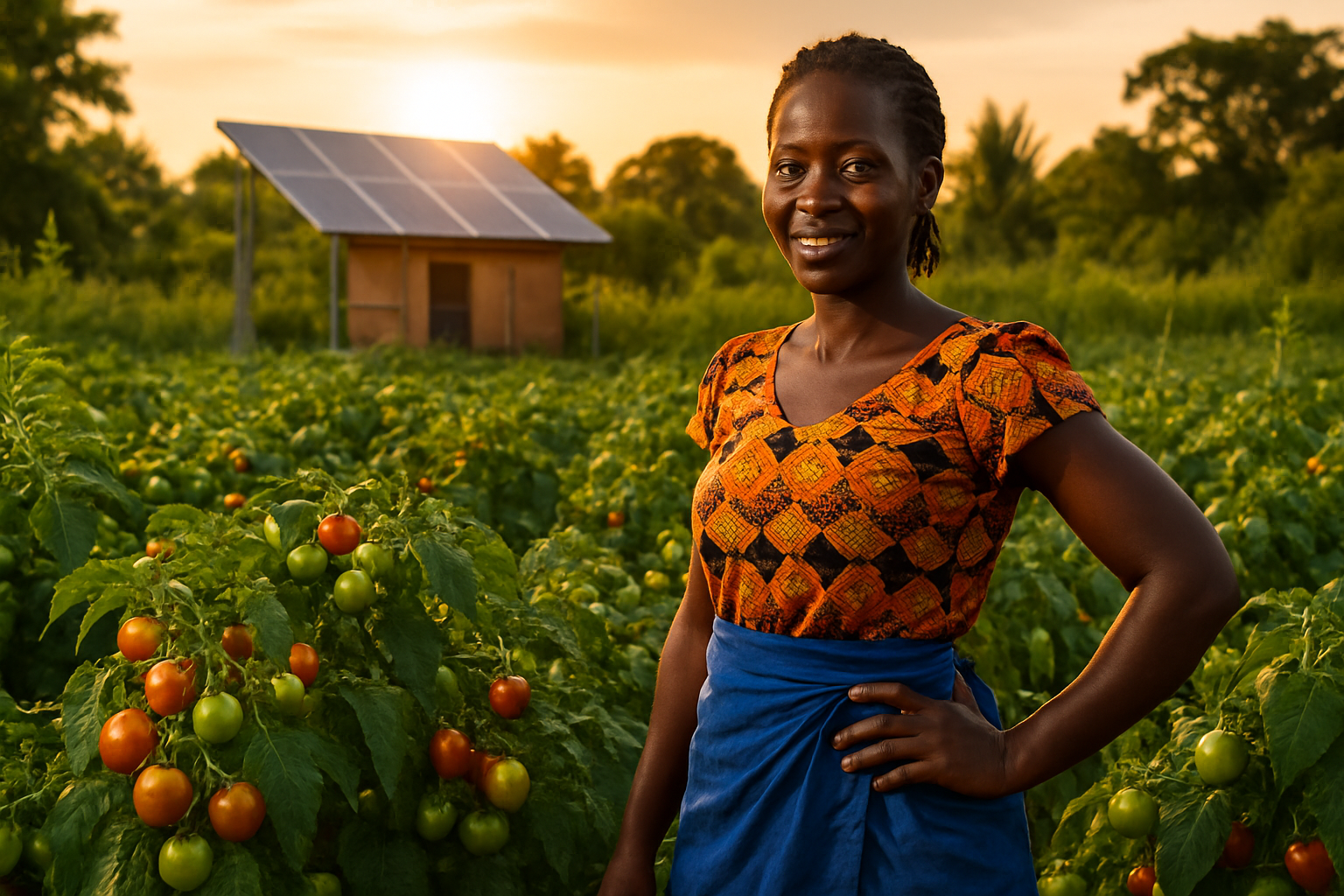
Her company deploys solar-powered cold rooms and AI-assisted crop monitoring directly to smallholder farming communities, cutting post-harvest losses by 30% across its network. The less-reported number: participating farmers have seen household incomes rise by 28%, a figure that points to how much money was previously evaporating alongside the rotting produce.
What rotting tomatoes taught 1,500 Ugandan farmers
Sub-Saharan Africa loses an estimated 30–40% of its food after harvest each year, according to the UN Food and Agriculture Organization. For smallholder farmers, that loss doesn’t just mean less food — it means the money they already spent on seeds, water, and labor vanishes with the crop. Nakawuki’s model attacks that gap directly by placing solar cold storage at community hubs, so produce that would spoil overnight can now survive long enough to reach buyers at higher prices.
The AI layer tracks temperature, moisture, and spoilage risk in real time, sending alerts to farmers via mobile phone — a low-cost, low-bandwidth solution suited to rural Uganda, where electricity grids are unreliable but mobile coverage is widespread. That design choice is what separates her approach from earlier cold-chain projects that required stable grid power and failed when the lights went out.
To date, the network covers 1,500 farmers. Nakawuki has said her target is to reach 10,000 smallholders across East Africa within three years, with expansion into Tanzania and Rwanda already in planning.
The Commonwealth award and what it unlocks
The Commonwealth Young Person of the Year is not purely ceremonial. Winners are formally presented at the Commonwealth Heads of Government Meeting, placing them in direct conversation with prime ministers and presidents across 56 member states. For an agri-tech founder still scaling her operations, that access to government procurement discussions and development finance networks is difficult to price.
Nakawuki is one of a growing cohort of African entrepreneurs reframing food security as a technology and logistics problem rather than purely an aid problem. Her solar farming model in Uganda mirrors approaches being tested in Kenya, Ethiopia, and Nigeria, but the Commonwealth platform gives her story international traction that most local innovators never reach.
Why the income gains may matter more than the loss figures
The 30% reduction in post-harvest losses is the headline statistic, but the 28% income increase across participating households is arguably the more telling metric. It means farmers are not just losing less — they are capturing more value per kilogram, likely because preserved produce can be sold to higher-paying urban markets rather than offloaded at a discount to local traders who know the crop will rot within hours.
That economic logic is self-reinforcing: higher incomes let farmers reinvest in seeds, irrigation, and better crop variety, which produces higher yields for the cold storage system to protect. Food security advocates have long argued that breaking this cycle requires exactly the kind of infrastructure-plus-income model Nakawuki has built.
Stories like hers also echo broader conversations about how pay and recognition inequities hold back innovation in the Global South — the same way Emmy Rossum’s pay gap only closed once it became public, structural gaps in agri-tech funding for African women founders often only close when external validation forces the issue. Winning the Commonwealth award is precisely that kind of forcing function.
Africa’s food system is betting on founders, not just aid
Nakawuki’s recognition arrives as international development banks shift more capital toward private agri-tech solutions in Africa. The African Development Bank’s $1 billion Technologies for African Agricultural Transformation program has specifically identified post-harvest loss reduction as a priority investment corridor for 2025–2030.
That funding environment means Nakawuki’s timing is good. The Commonwealth prize gives her a credibility stamp that makes grant applications, impact investment pitches, and government partnership talks considerably easier. Her next public milestone will be a presentation at the Commonwealth Heads of Government Meeting later this year, where she is expected to call for continent-wide cold-chain infrastructure standards — a policy ask that, if adopted, would reshape how African governments procure and subsidize agricultural storage.
For the 1,500 farmers already in her network, the stakes are more immediate: a harvest season where the tomatoes actually make it to market.