Fully autonomous, AI-controlled drones have killed human soldiers in combat for the first time, according to a senior figure in the Ukrainian defence industry, New Scientist reported this week. The confirmation marks a historic — and deeply unsettling — threshold in the history of warfare: a machine selected a human target and acted on that decision without a person in the loop.
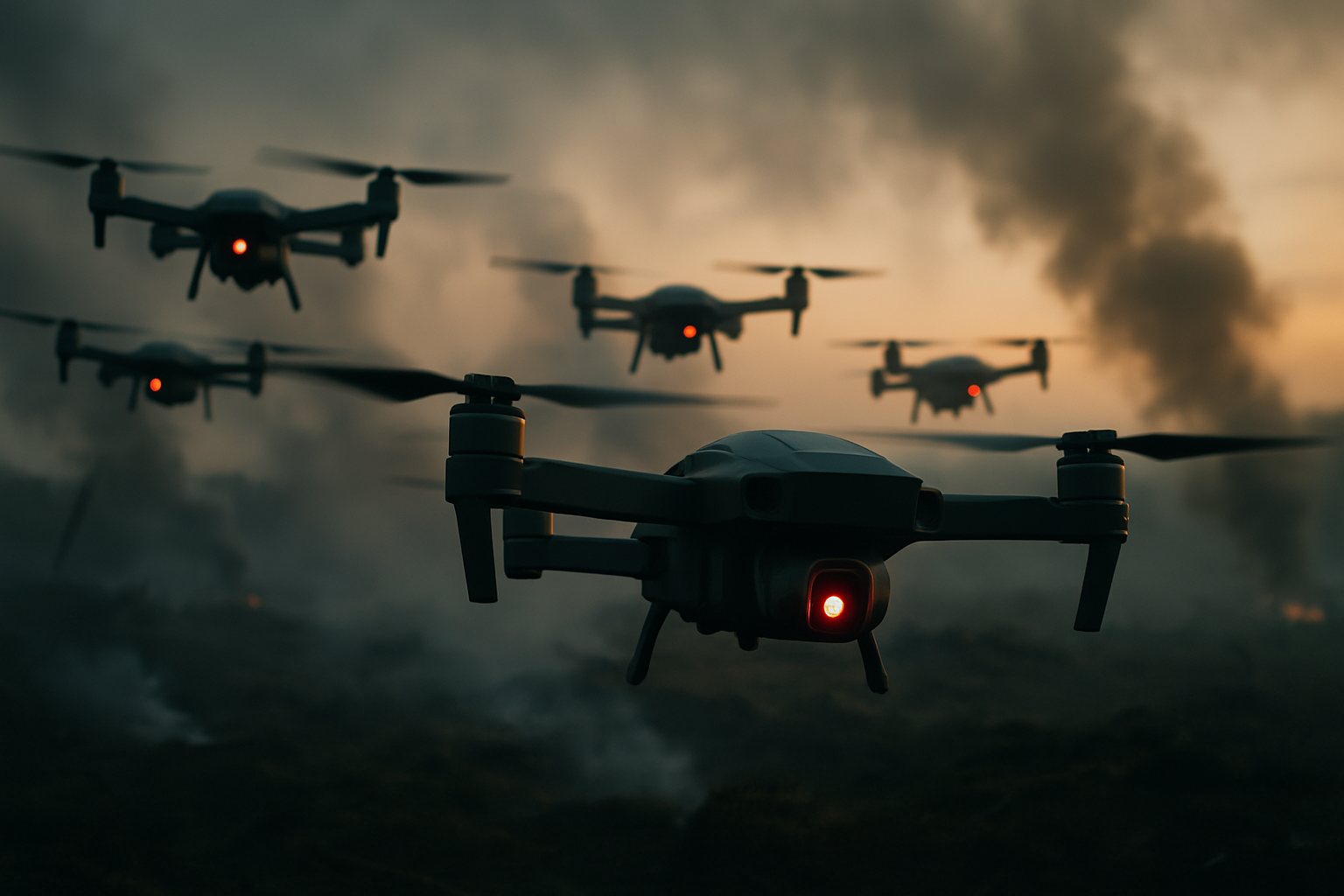
The non-obvious detail buried in this story: the drones in question were not exotic prototypes developed in a government lab. They were adapted from commercially available hardware, upgraded with computer-vision software capable of identifying and tracking soldiers in real time. The leap from hobby-grade quadcopter to autonomous killer required far less infrastructure than most defence analysts had publicly estimated.
How Autonomous AI Drones Made the Kill Decision
Traditional armed drones still require a human operator to authorize each strike. These new systems are different. The AI identifies a target — a moving human figure in a defined combat zone — locks on, and engages without waiting for a remote pilot to press a button. The Ukrainian defence source described the kill chain as fully automated from detection to detonation.
Ukraine has been one of the most aggressive adopters of drone technology since Russia’s full-scale invasion began in 2022. The country’s defence tech sector has iterated at a speed that traditional procurement cycles cannot match, fielding first-person-view (FPV) drones, loitering munitions, and now, apparently, fully autonomous systems. This latest development shows Ukraine leveraging every technological edge available in its fight to defend its sovereignty and territorial integrity against Russian military aggression.
The specific engagement details — when it occurred, the number of casualties, and the exact system used — have not been publicly disclosed, consistent with operational security. What the Ukrainian source made clear is that the milestone has already passed; this is not a future scenario being war-gamed in a think tank. It happened.
Why This Crosses a Line That Experts Have Long Feared
Arms-control researchers and AI ethicists have warned for years that lethal autonomous weapons — sometimes called “killer robots” — represent a categorical shift in how wars are fought and who bears moral and legal responsibility for deaths. When a human pulls a trigger, accountability exists. When an algorithm does, it becomes far murkier.
International humanitarian law requires that combatants distinguish between soldiers and civilians — a judgment that, critics argue, no current AI system can reliably make under the chaotic, ambiguous conditions of a real battlefield. The concern is not hypothetical anymore. Autonomous AI drones have now demonstrated they can act on that judgment, whether or not the judgment is sound.
The International Committee of the Red Cross has called for legally binding rules on autonomous weapons systems, arguing that meaningful human control must be retained over life-and-death decisions. Talks at the United Nations have stalled repeatedly, with major military powers — including the United States, Russia, and China — resisting hard limits that could constrain their own programmes.
Ukraine’s AI Battlefield and What Comes Next
Ukraine’s embrace of AI drone warfare is partly a matter of necessity. Russia has electronic-warfare systems that can jam the radio signals used to pilot conventional FPV drones, cutting the operator’s link at a critical moment. Autonomy is, in part, a jamming countermeasure: a drone that doesn’t need a live radio connection to complete its mission cannot be severed from its operator, because there is no operator to sever.
That practical logic is likely to accelerate adoption on both sides of the conflict — and eventually in every military that can access the underlying software. Once the barrier is broken and the technology is proven in combat, the pressure to deploy similar systems becomes enormous. Ukraine’s AI battlefield innovations have repeatedly been reverse-engineered or independently replicated within months.
The development also raises questions well beyond the current conflict. If commercially sourced hardware can be weaponized with autonomous targeting at relatively low cost, the barrier to entry for non-state actors — insurgent groups, criminal organizations, terrorist cells — drops sharply. This is the proliferation risk that defence analysts have consistently flagged as the most dangerous long-term consequence of the autonomous-weapons revolution.
For context on how rapidly AI is reshaping institutions and accountability structures, a Treasury watchdog review earlier this year highlighted how quickly AI-driven auditing tools are being deployed in high-stakes government settings — often outpacing the regulatory frameworks meant to govern them. The pattern is consistent: the technology moves; the rules follow slowly, if at all.
The Clock Is Running
Arms-control advocates are now pointing to this week’s disclosure as proof that negotiations over lethal autonomous weapons are no longer a preventive exercise — they are a catch-up exercise. Every month without a binding international framework is a month in which more militaries, and potentially non-state actors, bring autonomous AI drones to operational status.
Ukraine’s defence industry crossed the threshold first, in the context of a defensive war against an invading force. But the technology does not stay in one place. What was deployed on a frontline in eastern Europe this year will be studied, copied, and adapted globally. The question policymakers now face is no longer whether autonomous AI drones will kill — it is who will be allowed to deploy them, under what rules, and with what consequences when they get it wrong.